A Polish-made machine can repair potholes in minutes, offering a quick fix for surface damage. However, Spain’s road network needs €13.5 billion for full restoration, as rapid patching cannot address underlying structural issues. Authorities weigh new technology against the scale of the problem.
Repairing Spain’s deteriorating road network now requires an estimated €13.5 billion, according to the Asociación Española de la Carretera. As budgets tighten and traffic volumes rise, a new technology is drawing interest: a Polish injection patching machine capable of sealing potholes in just minutes. But while the device offers speed and efficiency for minor repairs, experts caution it is no substitute for comprehensive road reconstruction.
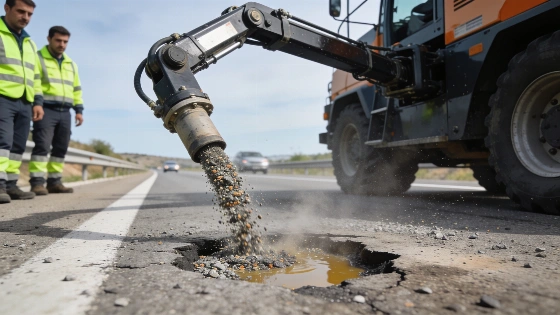
The injection patcher, developed by Polish manufacturer HYDROG, uses a single articulated arm to clean, seal, and fill potholes. The process begins with a blast of compressed air to remove debris and moisture, followed by a layer of bituminous emulsion to ensure adhesion. A mixture of aggregate and emulsion is then sprayed into the cavity, compacted by air pressure, and finished with a protective layer of gravel. The entire operation can be completed in a fraction of the time required for traditional milling and resurfacing.
This technology is not new, nor is it exclusive to Poland. Similar machines have been available in Spain since at least 2014, when Maquinter supplied a Strassmayr asphalt projector to a contractor in Almería. The method has also been studied in technical literature, with research highlighting that the durability of repairs depends heavily on the quality of materials, preparation of the cavity, and local conditions such as humidity and traffic loads.
Rapid Repairs, Limited Scope
For localized potholes where the underlying structure remains stable, the injection patcher can restore the surface in minutes and allow traffic to resume almost immediately. This is particularly valuable on busy roads, where lane closures can cause significant delays and increase risks for workers. However, the speed of the repair does not guarantee longevity. Factors such as the type of aggregate, emulsion, weather, and the condition of the road base all influence how long the patch will last.
Crucially, the machine is designed for surface-level defects—cracks, shallow potholes, and minor delamination. It cannot address deeper structural failures, drainage problems, or subsidence. Where the road base is compromised, full excavation and reconstruction remain essential. As a result, while the injection patcher can help slow the spread of damage and reduce maintenance backlogs, it is not a solution for Spain’s most serious road problems.
Spain’s Road Deficit
The scale of the challenge is stark. Of the 101,700 kilometers of road analyzed by the Asociación Española de la Carretera, nearly 34,000 kilometers require urgent reconstruction, and over 20,000 more show severe damage that should be addressed within four years. The Ministry of Transport acknowledges a €5.6 billion shortfall just for the national road network, which, while only 16% of Spain’s total roads, carries more than half of all traffic.
Heavy vehicles, especially trucks, accelerate wear and tear, causing rutting and fatigue in the asphalt. The cumulative effect of underinvestment and increasing traffic has left many roads vulnerable to rapid deterioration, especially during periods of heavy rain or temperature swings.
Technology’s Role and Limits
While the Polish machine has been presented as a breakthrough, its core technology is well established and already present in Spain. Its main advantage lies in reducing repair times, minimizing the need for large crews and equipment, and lowering the exposure of workers to traffic hazards. Quick interventions can prevent water from worsening cracks and potholes, but they do not replace the need for ongoing monitoring, safety measures, and, where necessary, full-scale reconstruction.
The Ministry of Transport has announced a €1.6 billion plan to upgrade nearly 5,000 kilometers of roads between 2027 and 2031, prioritizing routes with the most severe structural damage. There is no official confirmation that the specific Polish machine will be adopted nationwide, and even if it were, it would only address a fraction of the maintenance backlog.
As Spain weighs new technologies against the scale of its infrastructure deficit, the injection patcher stands out as a tool for targeted, rapid repairs—not a cure-all. The country’s road crisis will require both innovation and sustained investment to ensure safe, reliable travel for millions of drivers.