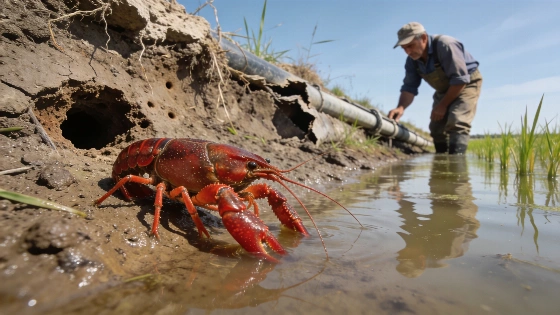
The American red swamp crayfish, once introduced to Andalusia for economic gain, has become an unstoppable force in the Guadalquivir marshes and Doñana. Its presence has altered ecosystems, threatened native species, and created a new industry that Spain can no longer simply remove.
In 1974, over 6,000 American red swamp crayfish were released into the Guadalquivir marshes near La Puebla del Río, backed by institutional support and legal approval. The goal was to create a new economic resource for the region. Five decades later, the species—Procambarus clarkii—has transformed the landscape, and Spanish authorities now admit that eradicating it is technically impossible.
Origins and Expansion
Genetic research from the CSIC reveals that the 1974 introduction was not Spain’s first. A year earlier, crayfish from Louisiana were released near Badajoz, and together these two events seeded much of the species’ later spread across Europe. Unlike many invasive species, the Andalusian episode was not a clandestine act but a calculated move to boost local economies through aquaculture.
However, the plan quickly spiraled beyond control. The crayfish spread from the initial marshes into canals, rice fields, and connected waterways, outpacing any containment efforts. Today, the species is entrenched across the region, with management agencies focusing on control rather than eradication.
Ecological Impact
The red swamp crayfish has left a deep mark on Doñana’s wetlands. According to official data from MITECO, its burrowing erodes banks and damages hydraulic structures, while its feeding habits destroy aquatic vegetation, increase water turbidity, and disrupt nutrient cycles. The species preys on eggs, larvae, amphibians, fish, and invertebrates, undermining native biodiversity.
One of the most serious threats is the transmission of Aphanomyces astaci, the pathogen behind crayfish plague. While the American species is resistant, native European crayfish are highly vulnerable, compounding the risks posed by drought, habitat loss, and declining water quality.
Rice farmers have also suffered. Crayfish tunnels weaken levees and irrigation systems, causing water loss and complicating the management of flooded fields. Young rice plants are often cut or damaged during peak crayfish activity, leading to reduced yields and higher maintenance costs.
Integration into the Food Web
Despite the damage, the red swamp crayfish has become a staple in Doñana’s food chain. Over time, otters, herons, storks, and spoonbills have adapted to feed on the abundant crustacean. Studies from the Doñana Biological Station show that crayfish now make up a significant portion of the otter’s diet in several regions.
This ecological integration complicates any attempt at mass removal. A sudden population crash could deprive local predators of a key food source, especially during dry periods when alternative prey is scarce. Meanwhile, conservation projects continue to focus on restoring native species, such as the Iberian lynx, whose recovery efforts have drawn international attention.
Economic Dependence and Legal Conflict
The crayfish’s economic role is now deeply embedded in local communities. Towns like Isla Mayor have built industries around its capture, processing, and export, with Spain ranking as the world’s third-largest producer of Procambarus clarkii. Annual output ranges from 3,000 to 4,000 tons, mainly from Andalusia and the Valencian Community.
This economic reliance has fueled legal disputes. The species is listed in Spain’s Catalogue of Invasive Alien Species, and a 2016 Supreme Court ruling struck down exceptions that allowed commercial fishing. Lawmakers later amended regulations to permit controlled harvesting of invasive species present before 2007, provided it serves as a management tool and does not encourage further spread.
Strict rules now govern crayfish fishing in the Guadalquivir marshes. Only licensed fishers using registered gear can operate, and live specimens may only be transported to authorized facilities under conditions that prevent escapes. Free capture, possession, or movement of live crayfish is prohibited.
Looking Ahead
The case of the red swamp crayfish in Doñana highlights the long-term consequences of introducing non-native species for economic gain. What began as a promising venture has become a complex ecological and legal challenge, with no simple solution. As Spain continues to balance environmental protection with local livelihoods, the story serves as a cautionary example of how quickly an introduced species can reshape both nature and society.