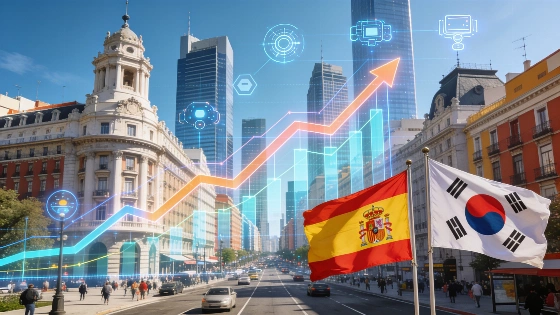
Spain has surpassed South Korea in total GDP, entering the world’s top 12 economies. Strong job creation and a booming services sector drive growth, but concerns remain over housing and infrastructure.
Spain has achieved a significant milestone by overtaking South Korea in total GDP, a development that has drawn attention from international financial circles and major media outlets. According to the latest data from the International Monetary Fund, Spain’s economy now exceeds $2.09 trillion, while South Korea, known for its leadership in technology and artificial intelligence, stands at $1.93 trillion. This shift places Spain back among the world’s twelve largest economies, a position it had lost more than a decade ago.
The country’s economic expansion has been notably robust since 2021, with growth rates consistently outpacing the eurozone average. Spain’s GDP growth has tripled that of its European peers, driven primarily by a dynamic services sector and a surge in employment. Unemployment has fallen to its lowest level since 2008, and job creation remains strong, fueled in large part by the arrival of foreign workers, especially from Latin America.
While these headline figures have earned praise from institutions such as Goldman Sachs and Jefferies, the domestic debate remains intense. Critics argue that much of the new growth is extensive rather than intensive, benefiting those entering the labor market but not necessarily translating into greater wealth for the broader population. Rising demand has also put pressure on housing and public services, with some analysts warning that infrastructure may not keep pace with demographic changes.
International observers, including Bloomberg, have highlighted Spain’s unique approach. Unlike many countries that have tightened immigration policies, Spain has moved in the opposite direction, implementing large-scale regularization measures that have granted residency to over a million undocumented migrants. This liberal stance has expanded the workforce and boosted consumption, with experts estimating that around 80% of jobs created since 2022 have gone to foreign-born workers.
Tourism remains another pillar of Spain’s economic strength. The sector now accounts for nearly 13% of GDP and has set new records, partly due to travelers avoiding conflict zones in the Middle East. Despite the surge in demand, inflation has not spiraled out of control, thanks in part to Spain’s significant investment in renewable energy, which has cushioned the impact of global energy price shocks.
However, the sustainability of this growth is under scrutiny. The rapid population increase has exposed weaknesses in housing supply and public infrastructure. Some experts describe Spain as a country of 50 million residents with infrastructure designed for 40 million. Public investment lags behind the European average, and the eventual end of EU recovery funds could present new fiscal challenges.
Productivity remains a key concern. Although Spain has begun to invest in technology and artificial intelligence—such as public backing for the chip manufacturer Openchip, dubbed 'the Nvidia catalana'—productivity per worker and per hour still trails behind South Korea and leading European economies. Analysts suggest that while Spain’s recent success has not depended on artificial intelligence, maintaining momentum will require a stronger focus on innovation and efficiency.
Spain’s economic transformation stands in contrast to South Korea’s more volatile performance, which is closely tied to the global semiconductor and AI markets. The Spanish model, characterized by demographic growth and a resilient services sector, offers an alternative path for eurozone countries struggling with stagnation. As noted in a recent Bloomberg column, Spain’s experience demonstrates that different strategies can yield impressive results even in a challenging European context.
For additional perspective on how economic shifts and political developments in other countries can impact broader trends, see the coverage of Colombia’s recent presidential election, where early results and electoral tensions have also drawn international attention: Colombia’s presidential vote count draws global focus.
Spain’s return to the top tier of global economies is not just a statistical achievement. It reflects deep changes in labor markets, migration policy, and the structure of the national economy. The country’s ability to sustain this growth will depend on addressing infrastructure gaps, improving productivity, and adapting to evolving global challenges. As the debate continues, Spain’s experience is likely to serve as a reference point for policymakers across Europe.