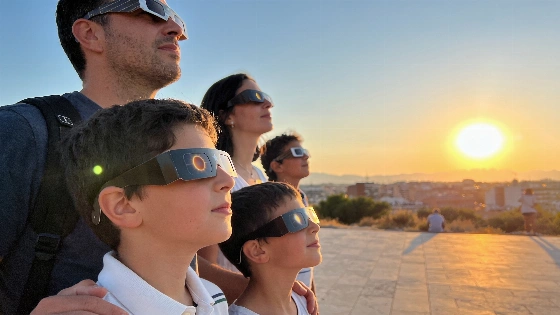
On August 12, 2026, Spain will witness its first total solar eclipse in more than a century. Hundreds of cities and towns are organizing public events, scientific talks, and safe viewing areas to mark this extraordinary astronomical event.
On the evening of August 12, 2026, Spain will experience a total solar eclipse crossing the country from west to east—a phenomenon not seen from the Iberian Peninsula in over a hundred years. As the sun sets, the shadow of the moon will sweep across key regions, drawing thousands to specially prepared observation points and public events.
The Instituto Geográfico Nacional (IGN) confirms that the path of totality will pass through major cities including A Coruña, Oviedo, León, Burgos, Bilbao, Guadalajara, Zaragoza, Valencia, Castellón, and Palma. In these areas, the sun will be completely obscured for a brief period, while the rest of Spain will witness a partial eclipse. To maximize visibility, experts recommend seeking locations with a clear western horizon, as the eclipse will occur during sunset and any obstruction could block the view.
Nationwide Events and Scientific Collaboration
More than 380 sites across Spain—ranging from municipal parks and natural reserves to observatories and public squares—will host activities designed to make the eclipse accessible and safe. Local governments, scientific institutions, and astronomy groups are coordinating live broadcasts, educational talks, hands-on workshops, and cultural events. The Observatorio de Yebes in Guadalajara will serve as a scientific hub, with researchers from the Instituto Geográfico Nacional, Instituto de Astrofísica de Canarias, and the Spanish Space Agency conducting real-time studies and sharing insights with the public.
Organizers urge attendees to plan ahead, as popular viewing spots may fill quickly. The IGN advises avoiding locations where buildings, trees, or mountains could block the sunset. The low angle of the sun during the eclipse will be a key factor for visibility.
Navarra's Ambitious Program
Navarra stands out with one of the most extensive public programs. The regional government has designated 20 official observation points, offering more than 42,000 spaces for visitors. These venues will provide amenities such as parking, restrooms, information booths, food services, water, shaded areas, and medical assistance. Attendance will be regulated to prevent overcrowding and ensure safety.
Beyond scientific talks, Navarra's schedule includes children's activities, art workshops, concerts, and street performances. Some events will extend into the night, allowing participants to observe the Perseids meteor shower, which peaks around the same dates as the eclipse. This coordinated effort is part of a broader national plan to manage the impact of three major astronomical events expected in Spain between 2026 and 2028, covering mobility, safety, and public outreach.
Zaragoza: A City in the Path of Totality
Zaragoza is among the cities directly in the path of totality. The partial phase will begin around 19:35, with total coverage starting at approximately 20:29 and peaking at 20:30. The total eclipse will last about one minute and 23 seconds, during which the moon will completely cover the sun. The city is preparing a comprehensive plan for crowd control, traffic management, cleaning, and tourist support. Special cultural programming is scheduled in Plaza del Pilar from August 10 to 12.
For those unable to attend in person, official live streams will be available, and the IGN's online tool will provide detailed information on timing and darkness levels for each municipality. The 2026 eclipse marks the beginning of a rare sequence, with another total solar eclipse set for August 2, 2027, which will be especially visible in southern Spain, including Cádiz, Málaga, Granada, Almería, Ceuta, and Melilla.
Safe Viewing: Essential Guidelines
Experts stress that proper eye protection is crucial. Only ISO 12312-2 certified solar viewing glasses should be used during all partial phases. Regular sunglasses, homemade filters, or improvised materials do not provide adequate protection. Certified eclipse glasses may be removed only during the brief period of totality—and only in locations where the sun is fully covered. They must be put back on as soon as any part of the sun reappears.
For those using cameras, telescopes, or binoculars, specialized solar filters must be installed on the front of the device. Looking through optical instruments with only eclipse glasses is dangerous, as lenses can intensify solar radiation. The IGN recommends inspecting glasses for scratches or damage before use and supervising children during observation.
Weather conditions will play a decisive role in visibility. Historical data from AEMET indicates significant regional differences in the likelihood of clear skies during the eclipse window. Checking local forecasts in the days leading up to the event is advised.
The 2026 total solar eclipse is set to become a landmark event for Spain, blending scientific discovery, public engagement, and cultural celebration on an unprecedented scale.