Hundreds of people remain in Madrid's Puerta del Sol as tenants demand urgent protection. The government is racing to agree on a decree before Tuesday's cabinet meeting, but its scope remains disputed.
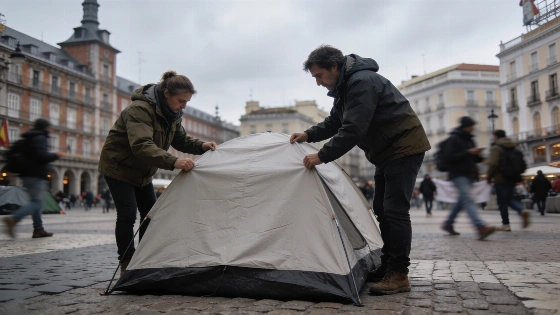
Hundreds of demonstrators remain camped in Madrid's Puerta del Sol as temperatures fall and rain is forecast. The protest has entered its third day. Tenant groups are also calling for action in several regions.
The government is due to approve a royal decree on Tuesday 29 September. It is meant to ease the housing emergency affecting millions of Spaniards. Negotiations are taking place under pressure from movements demanding automatic rental renewals, a rent freeze and a halt to evictions when no alternative accommodation is available.
Reuters, AP and AFP report that the cabinet is seeking measures that could provide immediate relief. The talks may also revive proposals that previously failed to pass through parliament.
Оценки численности субботнего марша резко разошлись: власти Мадрида говорили примерно о 25 000 участников, тогда как Ассоциация арендаторов заявила о более чем 300 000.
The campaign has given the proposal a human name: the "Decreto Mari Carmen". It refers to an 87-year-old woman who was recently evicted. For the tenants' union, her case shows the gap between the scale of the housing crisis and the protection available to people at risk of losing their homes.
The protest is no longer confined to Madrid.
The Sindicato de Inquilinas e Inquilinos de Madrid has called demonstrations in Seville, Zaragoza, Murcia, Asturias and Catalonia. The action could spread just as the governing parties try to agree on the decree's content and political backing.
Anadolu Agency reported that around 600 people were still staying in the Puerta del Sol camp on Monday. This is now a continuing occupation, not a single march.
Участники лагеря сформулировали протест как требование «права на жильё, а не бизнеса для немногих». Среди дополнительных требований — более жёсткая защита арендаторов и меры против мошенничества на рынке жилья.
Progressive forces including Sumar, Podemos, ERC, Bildu and BNG have backed urgent approval. Mónica García and other political leaders support rent freezes and an end to evictions. They also acknowledge that a decree with those aims is still far from agreed.
The right-wing opposition takes the opposite view. PP and Vox are expected to vote against the measure, according to AFP and AP reports.
Pedro Sánchez has called for residential use to take priority over tourist use. He has also urged the autonomous communities to apply the housing law approved in 2023.
Reuters says the prime minister wants regional authorities to give greater priority to permanent housing and enforce the existing legislation more consistently. The tenants' union is not satisfied. It wants direct rent controls, rather than measures focused mainly on construction or taxation.
Alberto Núñez Feijóo's opposition proposes cutting taxes and speeding up the construction of new homes. The tenants' movement rejects that formula without price limits.
The dispute is about more than the number of homes Spain builds. It is also about who carries the immediate burden of high rents and eviction proceedings.
Spain faces a shortage of 750,000 homes. The deficit could exceed one million by 2028 because annual construction remains below the level needed to close the gap.
That shortage explains the pressure on the decree. Building more homes may improve supply over time. The measures demanded by tenants are meant to protect people facing pressure now.
The two positions can coexist in theory. The negotiations described in the source material show no agreement on how far the government is prepared to go.
Madrid's mayor José Luis Rodríguez Almeida has added a local fight to the national dispute. He condemned the camp in Puerta del Sol and demanded a return to normal conditions. He also warned of legal consequences if the tents are not removed.
Officials have little room for a symbolic compromise. A narrow decree could secure a cabinet announcement. It would not meet the demands that brought protesters into the streets or settle the dispute over rent controls and evictions.
The housing emergency requires a measure that matches the stated scale of the problem. Otherwise, the government will meet its deadline without easing the pressure that created it.