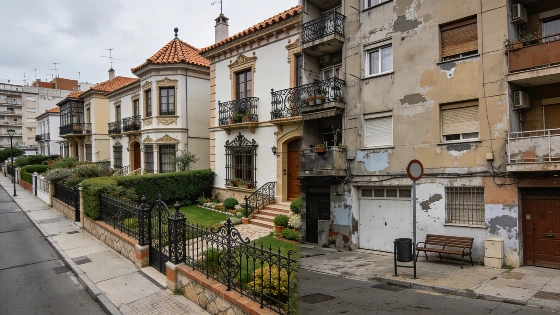
Spain’s new income map uses 2024 personal income tax returns to show gross average household income in more than 36,000 census sections. The figures expose sharp gaps within cities and across regions.
The highest-income tenth of Spanish neighbourhoods records average gross household income above €72,800. In the poorest fifth, it falls below €36,700.
The figures come from 2024 personal income tax returns and cover more than 36,000 census sections, Spain’s smallest available administrative units. The Instituto Nacional de Estadística (INE) publishes average gross income per household, before tax. The national median is €45,100. The INE’s 2024 household-income atlas, published on 19 October 2026, also reports average net income of €15,948 per person, up 6.1% year on year, and average net household income of €40,605, up 5.9%. These are different measures from the map’s gross household figures.
These are declared incomes, not a complete account of what households receive. The statistics exclude cash-in-hand and underground-economy earnings. They also miss tax avoidance through intermediary companies and income omitted from IRPF returns. The figures are capped at €167,076 per household and have a lower limit of €20,000, so multiple census sections can show the same value. The INE’s atlas draws on tax data from Spain’s Agencia Tributaria and the provincial tax authorities of the Basque Country and Navarre, assigning income to recipients’ places of residence. Its per-person measure includes children and people without income, so it does not measure average wages.
Users can search the map by entering an address or place name. It also shows where Spain’s richest 1% and poorest 1% are concentrated, alongside “income islands”, where a neighbourhood is surrounded by areas with very different income levels. Some of the sharpest contrasts fall between adjoining sections. The updated atlas lets users search by street or address, as well as by municipality, and examine individual census sections that can cover just a few streets. For its 2024 net-income measure, the INE set the threshold for the richest tenth of sections at more than €21,652 per person; the bottom decile was below €11,322.
The geography of the divide changes from city to city. Madrid’s main split runs between a wealthier north and a poorer south; in Seville, it runs from east to west. In Valencia and Zaragoza, higher incomes cluster in the centre while lower incomes are concentrated on the outskirts. Among provincial capitals, San Sebastián had the largest share of sections in the top tenth for net income, at 60.3%. Madrid followed at 39.3%; Bilbao and Barcelona recorded 33.9% and 31.6%, respectively.
Regional patterns are also visible. Southern Spain has more low-income neighbourhoods, and Extremadura and Andalusia have most of their neighbourhoods in the country’s poorest tenth. Navarra and the Balearic Islands sit at the other end of the scale. Euskadi does too: in each of these territories, barely 1% of census sections fall in the lowest national decile. In the INE atlas, Melilla had the highest share of sections below the bottom-decile net-income threshold, at 31.8%. Ceuta recorded 30.4%, while Alicante had 29.3%.
The map’s declared-income measure differs from the food-price pressures described in Europe’s cost-of-living protests. Municipalities at the high end include Pozuelo de Alarcón in Madrid and Matadepera in Barcelona; Marchagaz in Cáceres and Espadañedo in Zamora are among those at the low end. In the INE’s 2024 net-income figures, Matadepera averaged €28,607 per person, around 80% above the national average of €15,948. A municipal table shows each town’s income group. A “+” button opens the series back to 2015, the first year with aggregated municipal data.