Protests over living costs spread across Europe this weekend. In France, unrest damaged public buildings as food prices across the EU climbed 34% from August 2021 to August 2026.
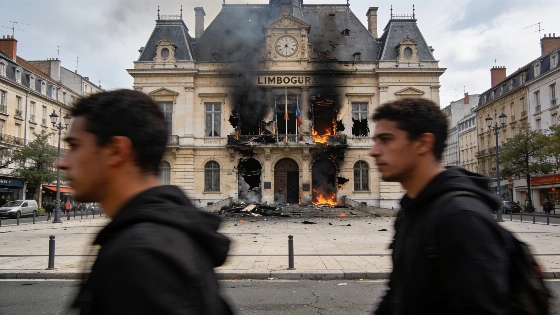
A section of the spire at Limoges city hall collapsed after the historic building caught fire on 17 October. Mass demonstrations in France brought together students and trade unions. Yellow Vest activists also took part, protesting the cost of living and deteriorating public services.
In Lyon, the emblematic tourist office at Bellecour square was set alight. Protesters entered Marseille’s town hall. Reuters described the unrest as among the worst violence France had seen in decades.
Agence France-Presse, citing France’s Interior Ministry, reported that nearly 2,400 people were arrested on 17 October. Around 1,000 police officers and gendarmes were injured, with seven seriously hurt. Clashes and attempted looting continued on 18 October, including an attempt to raid a luxury clothing shop in Lyon. President Emmanuel Macron condemned the violence and said those responsible for trying to bring down the Republic should be held accountable. Limoges mayor Guillaume Guérin said the right to demonstrate and public anger deserved to be heard, but called the destruction of public property unacceptable.
In Belgium, several hundred people, mostly young, demonstrated in Brussels on 17 October. Another protest took place in Liège. Police used tear gas and water cannon after accusing demonstrators of throwing objects and setting fires. Interior Minister Bernard Quintin said the situation had moved beyond protest and amounted to violence. He pledged to use all necessary means to restore order.
Belgian student groups pointed to rising education costs and reforms they said could make higher education less accessible. Secondary-school students had also demonstrated in recent weeks over education costs and access to learning materials. In France, protests grew out of student actions over school conditions and teacher shortages. Concerns about education budgets also featured. The education dispute has a Spanish parallel in the Madrid teachers’ march, held during an open-ended strike.
Portugal’s unions and housing-rights associations called for higher pay and better pensions. They also demanded stronger public services and measures to make housing more accessible. Organisers pointed to rising rents and mortgage costs.
Everyday expenses are squeezing household budgets. Al Jazeera reported separate cost-of-living demonstrations in France and Belgium, as well as in Italy and Portugal. National concerns shaped the actions in each country.
In Italy, demonstrations focused on economic conditions and rising prices. Clashes in Milan and Turin left people injured. Bologna also saw clashes that left people injured, while dozens were detained in Milan.
Even when inflation slows, prices can remain above earlier levels and leave households with less room for other spending. Housing weighs heavily on renters and young people in many cities. Low-paid workers are also struggling with essential costs.
In France, protesters called for greater purchasing power and better public services. Belgian student groups focused on the cost of education and access to it.
Eurostat data analysed by Euronews Business show that food and non-alcoholic drink prices in the EU rose 34% between August 2021 and August 2026. A gross monthly minimum wage bought 6% less food in Malta. Its buying power for food fell 5% in Spain and 4% in France, while rising in most of the countries studied.
The comparison excludes taxes and rent. It also leaves out other household costs, so it does not capture the full pressure on living standards.