Pedro, from Cartagena, says he does not plan to vote on 29 November. He sees no current option as likely to change things, though a credible proposal on housing and public services could persuade him to go to the polls.
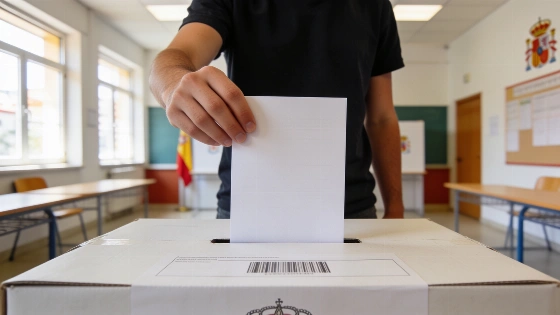
His position is one of several among five young people aged 18 to 24 interviewed by RTVE Noticias. Spain’s early general election, called by Royal Decree 806/2026 on 6 October, will elect all 350 members of the Congress of Deputies and 209 of the Senate’s 267 seats. The National Statistics Institute lists 38,728,356 eligible electors: 35,958,711 resident in Spain and 2,769,645 registered abroad. The campaign runs from 13 November to 27 November, ahead of polling day on 29 November.
An October barometer from Spain’s Centre for Sociological Research (CIS) found that 63.6% of respondents aged 18 to 24 said they would vote, the lowest proportion among the age groups surveyed. Its breakdown by sex put willingness to vote at 80% among women and 76% among men. Among young respondents who had chosen a party, the report listed PSOE, PP, Vox and Sumar. It did not include Frente Amplio, and some parties have argued that the survey favours the government. A separate provisional CIS pre-election study, Study 3584, was reported to put Vox at 23% among 18-to-24-year-olds, compared with 14% in 2023; among respondents aged 24 to 34, the figure rose from 12% to 23%. These are stated preferences, not actual turnout or final vote shares.
Álvaro, a 19-year-old vocational student from a town south-east of Madrid, has already decided whom to support. He describes voting as a responsibility and says education matters to him. Public healthcare and housing are also priorities.
Lucía, an 18-year-old from Vallecas, and Daniel, 21, from Leganés, plan to wait for more information during the campaign. Lucía says no party has yet won her support; she is concerned about public services and equality. Daniel wants his vote to help create a country where people can make ends meet.
Mikel, who lives in a village in the municipality of Sigüenza in Guadalajara, had initially expected to abstain. The housing crisis changed his mind. He became interested after visiting the encampment in Sol, and says the situation in Ceuta prompted him to compare parties’ positions. He wants Spain to improve and remain affordable, and says migrants should not all be criminalised. Migration has become a campaign issue amid increased arrivals in Ceuta and debate over the government’s policy. The government introduced a bill in 2026 intended to regularise more than one million undocumented migrants. A political analysis reported that 72% of Spaniards opposed irregular migration, while a majority supported legal routes to residency.
Housing pressure has also brought demonstrations and labour action. A student-led encampment in Madrid’s Puerta del Sol drew about 1,000 people at its height. The unions UGT and CCOO organised what was described as Spain’s first general strike in fourteen years, protesting the housing crisis. Prime Minister Pedro Sánchez proposed suspending evictions until 2030 and constraining rent increases, but the measures were blocked in parliament by the PP, Vox and Junts.
Political scientists Ana Salazar, president of the Association of Political Communication, and Lluis Orriols, a professor at the Carlos III University of Madrid, describe young voters as a diverse group. Orriols says abstention tends to fall as people become more involved in society, while Salazar notes that political identity develops over time. Orriols also says a first vote can build a lasting connection with a party, although that link may weaken if expectations are not met.
The campaign is unfolding amid a close contest over the balance of power. A 40dB polling analysis projected that the PP and Vox could together win 192 seats in the Congress, above the 176 needed for a majority. The projection is not an election result. The OSCE Office for Democratic Institutions and Human Rights sent a needs-assessment mission to Spain from 27 to 30 October after receiving an invitation to observe the election.
Most of the five say they follow politics only occasionally, mainly through social media or conversations with family and friends. They use traditional media less often. Salazar says online political content increasingly relies on emotional responses to prompt sharing, and argues that political organisations should ask young people what they need and give them a voice.