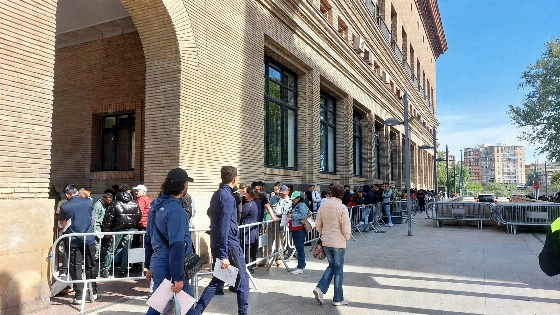
Why the Mass Legalization Process for Migrants Has Sparked a Frenzy and Debate in Spain. Spanish authorities have recorded a historic number of applications for migrant legalization. With two weeks remaining before the deadline, 900,000 requests have been submitted. The scale of the process has already surpassed all previous legalization campaigns.
Spain has seen an unprecedented surge in applications for the legalization of foreign nationals: according to official data, by mid-June, 900,000 requests for residence and work permits had already been submitted. This is an absolute record for the country — previous campaigns never exceeded 700,000 applications. At present, the authorities have started processing 360,000 cases, and only 15 days remain before the deadline for submissions.
The mass legalization procedure, initiated by the government of Pedro Sánchez, has become one of the most prominent political measures of the current legislature. The authorities aim to bring informal labor out of the shadows and grant rights to those who are already living and working in Spain without documents. According to EL PAÍS, the process is proceeding as planned, despite occasional disruptions and overload in municipal services and consulates.
For comparison, in 2005, when the last major legalization took place, 691,655 applications were submitted and 576,506 people were granted permits. Now, even before the end of submissions, the number of applications is already significantly higher. Officials note that many foreigners waited until the last moment to gather all the necessary documents, and the actual number of people without legal status turned out to be higher than official estimates.
The legalization initiative is supported by a broad coalition — from trade unions and employers to the Catholic Church. At one time, the PP also backed it, but later the party changed its stance under pressure from VOX, which consistently opposes mass legalization and insists on giving 'priority to national citizens' when distributing social assistance and services in regions where the parties govern jointly.
Among the challenges of the process are overloaded social services, delays in issuing social security numbers, and difficulties in obtaining criminal record certificates at consulates. Authorities attribute this to the scale of the campaign and emphasize that the procedure must be as transparent and legally secure as possible. The legalization decree is already being challenged in the Supreme Court by Madrid, VOX, and a number of organizations, but so far they have not succeeded in suspending its effect.
Most migrants seeking legalization have been living and working in Spain for a long time, often having arrived on tourist visas, mainly from Latin American countries. According to official statistics, last year 36,775 people arrived in the country by sea and land — just a small fraction of the total number of undocumented migrants, most of whom entered the country by air. Organizations working with migrants have previously estimated the number of foreigners without documents at 840,000.
Many of those who applied work in sectors where there is a shortage of local employees: construction, agriculture, childcare and elder care, cleaning. According to estimates, each regularization brings the budget approximately 4,000 euros in taxes and contributions. Authorities emphasize that bringing migrants out of the shadow economy en masse will help strengthen the labor market and increase tax revenues.
In parallel with the Spanish campaign, a new European Pact on Migration and Asylum has come into force, tightening admission rules and speeding up deportation procedures. However, these measures do not apply to those already in Spain and participating in the current regularization. Debates on the consequences of mass status grants continue in the country, but for thousands of families, this is a chance to obtain legal rights and protection.
In the context of other large-scale social initiatives in Spain, it is worth noting that regional governments are also actively investing in infrastructure and the social sphere. For example, a project to modernize schools and tackle heat was recently launched in Valencia — details on the allocation of 180 million euros for these purposes sparked broad public resonance.
For reference: Since 1986, Spain has held six major regularization campaigns for migrants. Each was accompanied by sharp political debate and temporary disruptions in public services, but legalized tens or even hundreds of thousands of people. Experts note that such measures become inevitable amid a growing number of foreigners and the overload of standard residency permit procedures.