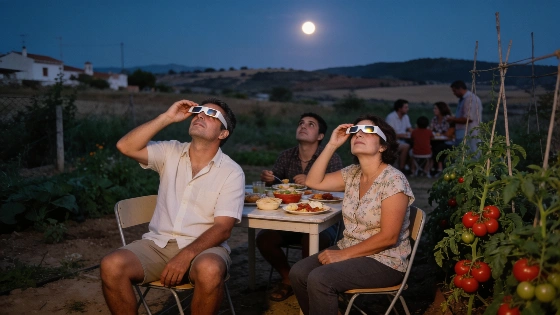
A rare astronomical event is approaching Spain on Wednesday, August 12: a total solar eclipse whose path of totality will cross the northern Iberian Peninsula. The eclipse will be visible in some form across a much wider area, but only locations within the Moon’s narrow umbral shadow will see the Sun completely covered. Families and friends are planning to gather in open spaces, from rural gardens to mountain plains, and watch together.
Testimonies collected by EL PAÍS indicate that many residents are organizing informal gatherings and bringing food and drinks to share as they watch. Some plan to set up tables and chairs near their vegetable patches; others will head to local viewpoints or beaches. The event’s rarity has prompted people to choose both the location and company for this evening with care.
In Archilla, Guadalajara, nearly the entire community is expected to gather outdoors. Similar scenes are anticipated elsewhere, as the eclipse offers a chance to reconnect with neighbors and loved ones. The shared excitement has been compared with that surrounding major sporting finals. The event is bringing people together for an experience beyond ordinary routines.
The total phase will be brief: NASA calculations put its maximum duration at about 2 minutes and 18 seconds at the point of greatest eclipse. The Moon’s shadow is expected to travel across Earth at roughly 3,700 kilometres per hour. Timing will vary by location. Totality is estimated at around 20:28 in León; Zaragoza’s estimate is 20:29, while Valencia’s is 20:32. These are local estimates, and the precise experience depends on an observer’s position within the path.
Organizers and local authorities have stressed the need for safe viewing. Certified solar-viewing glasses are needed during the partial phases; ordinary sunglasses do not provide adequate protection. Eye protection should stay in place before and after totality, and be removed only during the brief interval when the Sun is completely covered. In Catalonia, where tens of thousands of visitors are expected, local governments are coordinating security and mobility plans. Read more about the region's preparations for the historic eclipse here.
The event also falls within a rare two-year sequence for Spain: another total solar eclipse is scheduled to cross southern Spain on August 2, 2027. The two paths differ, so the 2026 eclipse will not be total across the country, and next year’s chance will be concentrated farther south. Spain’s National Astronomical Observatory holds historical records of total solar eclipses dated February 3, 1916, and August 30, 1905.
For many communities, the eclipse is as much a shared occasion as an astronomical one. Residents are planning picnics and evening meals, with reunions also on the calendar; some hope to introduce children to astronomy, while others welcome a rare moment to pause with family and friends. The mix of scientific interest and social connection is set to make August 12 a memorable date for those gathered beneath the path of totality.