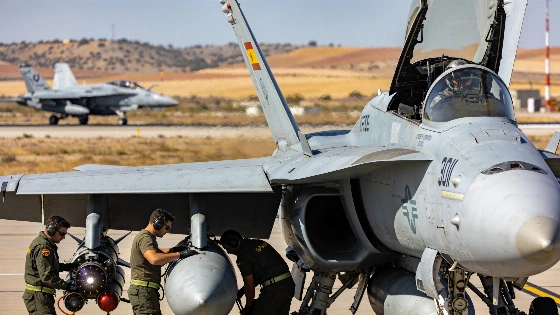
F-18 and Eurofighter jets will launch live missiles over the Gulf of Cádiz as Spain’s Air and Space Force stages its most advanced combat exercise yet. The operation will test new air-to-surface capabilities and sharpen anti-drone tactics amid heightened NATO vigilance.
This September, the skies over Cádiz will see live missile launches as Spain’s Air and Space Force carries out its most complex combat exercise yet. For six days, F-18 and Eurofighter jets will fire real missiles and run anti-drone operations, pushing the country’s training to a new level.
The exercise, called Atlante 26, will bring Spain’s main fighter squadrons to Morón Air Base from 13 to 18 September. This year, for the first time, pilots will launch live air-to-surface missiles at naval targets, in addition to the usual air-to-air and anti-drone drills. The Gulf of Cádiz will serve as the test area, with Morón as the main command center. According to Zona Militar, Atlante 26 is one of the Spanish Air Force’s top training events of the year.
The execution phase of Atlante 26 is scheduled for 14–18 September, with September 13 dedicated to preparatory procedures, safety briefings, and deployment.
This year’s drill stands out for its expanded weapons and more demanding scenarios. Last year focused on air-to-air missiles against SCRAB II and SCRAB III targets. Now, the program adds live cannon fire at drone-towed targets and, for the first time, air-to-surface missile launches at a ship. NH90 helicopters from Ala 48 and paratroopers from EZAPAC will also take part. All major fighter wings—Ala 11, 12, 14, 15, and 46—are involved, covering the full F-18 and Eurofighter fleet.
Morón will host these main fighter units, bringing together Spain’s F-18 and Eurofighter squadrons. The operation starts on 13 September with briefings and preparations, then moves to live-fire drills from the 14th. Each day will test different weapons in set time slots, ending with a phased withdrawal on the 18th. NH90 helicopters, EZAPAC, and command and control teams will support the missions.
The exercise also extends beyond the air base. In Huelva, the Centro de Experimentación de El Arenosillo (CEDEA) will remotely control both aerial and maritime targets. This INTA-run facility specializes in missile tracking and unmanned vehicle testing, making it a key part of the drill. Official sources say CEDEA/INTA’s role shows how test range infrastructure and advanced guidance systems are now central to Spanish exercises.
A key innovation in Atlante 26 is the shift from exclusively air-to-air scenarios to live-fire missions against maritime targets, significantly increasing the tactical complexity of the exercise. This evolution reflects Spain’s intent to train for multiple modern combat scenarios, including strikes on surface vessels and counter-drone operations.
Zona Militar
Anti-drone warfare is now a practical concern. The C-UAS (Counter-Unmanned Aircraft Systems) missions in Atlante 26 follow repeated airspace violations on NATO’s eastern flank. After the launch of Eastern Sentry in 2025 and recent Spanish-led night operations over Poland, Spain is applying those lessons at home—training its own units to counter drones in realistic conditions.
The timing is deliberate. Spain is updating its combat aviation. While F-18s are still in service, the Halcón I and II programs will soon add 45 new Eurofighter jets, bringing the total to 115 and gradually replacing older planes. Atlante 26 is not a ceremonial handover, but it does put both generations in the air together, under live-fire rules and strict safety controls. Airspace and sea zones will be tightly managed, with real-time coordination between air traffic and naval authorities.
Atlante 26 is a direct response to the changing demands of modern warfare, where drones and hybrid threats require new tactics and faster decisions. By expanding the scope and realism of its drills, Spain’s Air and Space Force is showing it intends to keep pace with NATO and the security challenges on Europe’s borders. As the exercise unfolds, Spain’s message is clear: it is preparing for the conflicts ahead, with live ammunition and no room for error.