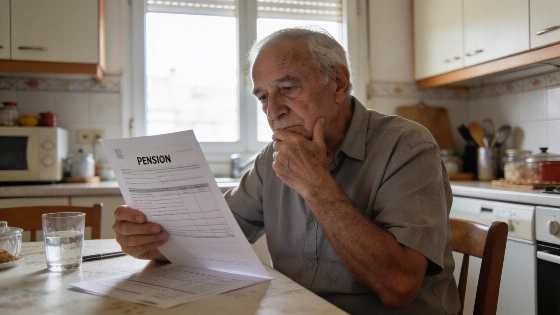
Domingo García spent over 46 years paying into Spain’s Social Security system, only to see his pension permanently reduced for retiring early. His case highlights a legal framework that punishes long careers with irreversible cuts, sparking debate over fairness and reform.
Domingo García worked in Spain for more than 46 years, paying into the Social Security system the entire time. When he decided to retire early, he was hit with a permanent reduction to his pension—a penalty that will follow him for the rest of his life. For García, and many others in his position, the numbers don’t add up: decades of contributions, but no way to avoid the cut.
Even after surpassing the thresholds for the most favorable pension calculations, Spanish law still reduced García’s monthly payment because he left the workforce before the official retirement age. "I have a penalty for life," he says, echoing the frustration of thousands of long-serving workers.
Starting in 2026, the full pension age in Spain will rise to 66 years and 10 months, or 65 years only for those with at least 38 years and 3 months of contributions.
How the system penalizes long careers
Spain’s pension rules are complicated, with different percentages and thresholds. The system rewards years of contributions up to a point: with 36 years and six months, retirees can claim 100% of their base. But if someone retires early, a separate set of reduction coefficients applies, based on how many months early they leave and how long they’ve worked. These coefficients are set out in tables, with key thresholds at 38 years 6 months, 41 years 6 months, and 44 years 6 months of contributions. After 44 years and six months, no further benefit is added—the penalty for early retirement stays the same, no matter how many extra years someone has worked.
In García’s case, the law recognized his long career but still imposed the penalty. The maximum reduction for voluntary early retirement is 13% for those with at least 44 years and six months of contributions, and up to 24% for involuntary cases. The exact cut depends on how many months early someone retires, but the rule is clear: the reduction is permanent, regardless of how long a person has paid in. In 2026, the reduction for early retirement can range from about 2.8% to 21%, depending on the situation, and these cuts last for life.
Legal barriers to reversal
Spanish law, specifically articles 207 and 208 of the Ley General de la Seguridad Social, locks in this approach. The reduction is applied at the moment of early retirement and stays in place for life. Even if a pensioner later reaches the standard retirement age, the penalty does not go away. There is no mechanism for recalculating or restoring the full amount. This permanent penalty has become a point of public debate, especially for those with very long contribution histories.
In September 2026, Spanish public broadcaster RTVE reported a surge in proposals to eliminate penalties for early retirees with more than 40 years of contributions, reflecting a growing public and professional demand for reform. However, as of late 2026, no legislative changes have been enacted to address this issue.
There are a few exceptions, but they are narrow. Some public sector workers under the Régimen de Clases Pasivas can retire at 60 with full benefits if they have 30 years of service. Other exceptions exist for certain disabilities or hazardous jobs. For most people, though, the rules are strict and the penalties unavoidable.
Political promises, legislative stalemate
In November 2025, the Spanish Congress approved a motion urging the government to eliminate reduction coefficients for those with at least 40 years of contributions. The vote—180 in favor, 170 abstentions—showed political interest but had no legal effect. A later amendment to a law on mutual societies, which would have allowed recalculation for current pensioners, was rejected in June 2026 by a wide margin.
Official figures show the scale of the problem: 881,736 Spaniards currently receive early retirement pensions after contributing at least 40 years, with nearly half a million in the voluntary category. The government estimates that removing the penalties would increase annual spending by over €3.3 billion, a cost that has so far blocked any real reform. This fiscal impact remains a major obstacle to changing the law.
García’s campaign has become a rallying point for those who feel let down by a system that values long service only up to a limit. As he and others push for change, the legal and financial barriers remain high. Anyone in a similar situation is advised to review their pension resolution carefully, checking the type of retirement, months of anticipation, recognized contribution period, and the applied coefficient. Without these details, challenging the calculation is nearly impossible.
Spain’s pension system, as it stands, sends a clear message: even the longest careers are not protected from lifelong penalties if retirement comes early. The political will for change exists, but the cost and the law’s inertia continue to outweigh the demands of workers like Domingo García. Until lawmakers move beyond symbolic gestures, the promise of fairness for Spain’s longest-serving workers remains out of reach.