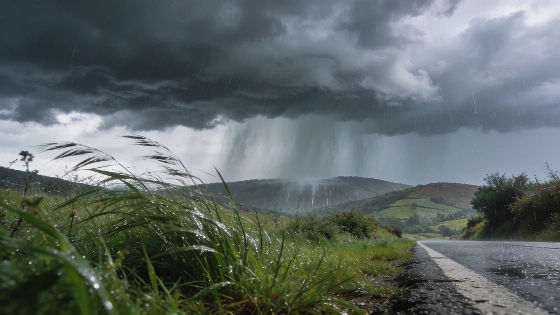
Thick clouds rolled over northern Spain on Sunday as a fast-moving cold air mass pushed in, sharply lowering daytime temperatures across much of the country. The State Meteorological Agency (AEMET) warned that the north would take the hardest hit, with afternoon storms and possible hail. RTVE and AEMET reported yellow weather warnings from 18:00 for Cantabria and Castilla y León, as well as País Vasco and La Rioja. The alerts focused on thunderstorms and hail.
Galicia and Asturias faced the worst of the unstable weather. By late afternoon, skies were expected to darken, with heavy rain forecast for northwest Galicia and isolated storms possible. The risk zone stretched east into northern Castilla y León and La Rioja, reaching the eastern Cantabrian coast, where strong downpours and hail could hit as the day ended. RTVE’s midday weather update confirmed very cloudy skies and heavy rain in northwest Galicia, with isolated storms possible.
Other regions saw a different story. While the west and north braced for rain, the Guadalquivir valley stayed hot, with temperatures potentially topping 35 degrees. Galicia faced a sharp drop in maximum temperatures, while the Cantabrian coast might see a slight rise in daytime warmth. Minimum temperatures were set to climb in most places, except for a dip in the southeast and a clear fall in the Canary Islands. Telecinco and Infobae both noted that parts of southern and inland Spain would still see highs above 35°C despite the general cooling.
Clouds covered the western half of the peninsula. Low clouds and mist lingered along the Mediterranean, the Strait and the Balearic Islands. The rest of Spain saw patches of mid-level clouds but little rain. In the Canary Islands, mid-level clouds mixed with high haze, and showers or isolated storms could hit the western islands.
Regional forecasts showed a patchwork. In the Basque Country, afternoon storms could turn severe in Vizcaya and Álava, where hail was possible. AEMET specifically highlighted both areas as at risk of severe thunderstorms and hail on September 27, 2026, Telecinco reported. Northern temperatures could spike. Castilla y León and La Rioja expected scattered showers, with a risk of strong storms in western La Rioja. The Mediterranean coast, including Catalonia and Comunidad Valenciana, was expected to see mostly high clouds, with only a slight chance of weak, scattered rain, mainly along the coast. In Andalusia, the west could get light rain while the Guadalquivir valley stayed hot. The Strait and Cádiz province faced strong easterly winds, with gusts that could reach dangerous speeds.
Euronews and Notimerica described the episode as the start of broader autumnal cooling. From September 28 onward, a deeper Atlantic depression was expected to bring further rain and wind, along with a sharp temperature drop across multiple regions.
Winds added to the unsettled conditions. Moderate easterlies swept Alborán and the Strait, while some spots in Cádiz faced very strong gusts. The Canary Islands saw moderate winds from the east or northeast, while the Balearic Islands expected moderate easterlies. Across the rest of the peninsula, Mediterranean breezes and shifting winds took over. Inland, winds leaned south; in the north, patterns kept changing.
This unsettled weather coincided with Spain’s preparations for the annual winter time switch, as reported earlier. The timing showed how quickly conditions can change as autumn’s swings came into view.
Sunday’s weather in Spain brought sharp contrasts: some regions braced for storms and a sudden chill, while others held on to summer heat. Residents and travelers needed to stay alert to local forecasts as conditions changed.