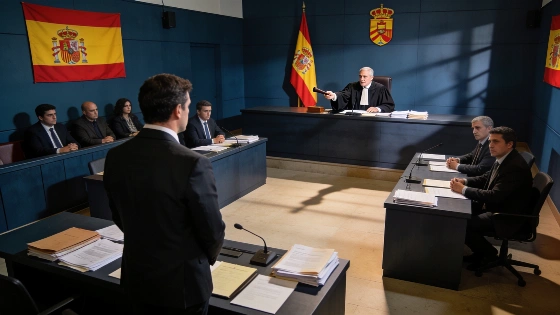
The Supreme Court has granted a notably reduced sentence to Víctor de Aldama in the ‘caso Koldo’ corruption case. The decision, based on his cooperation, has reignited debate over the fairness of negotiated justice in Spain.
The Supreme Court’s recent ruling in the ‘caso Koldo’ has reignited debate over the use of negotiated justice in Spain’s legal system. Víctor de Aldama, identified as a key figure in the corruption scheme, received a significantly lighter sentence after cooperating with authorities. This outcome has drawn criticism for the apparent disparity in penalties between Aldama and other defendants, including José Luis Ábalos and Koldo García, who received much harsher sentences despite playing lesser roles in the case.
Under Spanish law, incentives such as reduced sentences are offered to defendants who confess, repair damages, or collaborate with investigations. The intention is to facilitate the judicial process and secure evidence that might otherwise be difficult to obtain. However, the ‘caso Koldo’ ruling has highlighted concerns that such arrangements can lead to outcomes perceived as disproportionate or unfair, especially when the main orchestrator of a crime benefits most from cooperation agreements.
The court justified Aldama’s leniency by emphasizing the importance of his collaboration in uncovering the scheme. Yet, critics argue that the case could have been prosecuted without his assistance, given the scale and visibility of the corruption involved. The ruling also applied legal provisions in a notably flexible manner, granting Aldama the benefits of confession and allowing for the suspension of multiple sentences, despite the fact that he did not meet all the usual requirements, such as timely admission of guilt or full economic restitution.
This approach has revived longstanding debates in Spain and other countries about the risks of negotiated justice. In the 1980s, similar concerns arose in Italy when mafia and terrorism cases saw leaders—those with the most valuable information—receiving the greatest benefits for cooperating, while lower-level participants faced harsher consequences. The Spanish case now echoes those criticisms, with questions raised about whether the pursuit of efficiency in the courts is coming at the expense of proportional justice.
Legal experts note that while the law allows for exceptional suspension of sentences if the defendant’s circumstances and efforts to repair harm justify it, Aldama’s case stands out because he retained economic gains and did not fully compensate for the damage caused. The court’s decision to interpret these provisions generously has fueled public debate about the transparency and consistency of Spain’s judicial process in high-profile corruption cases.
For context, the ‘caso Koldo’ centers on allegations of large-scale fraud involving public contracts during the COVID-19 pandemic. The case has become a touchstone for broader discussions about corruption, accountability, and the effectiveness of Spain’s legal mechanisms for addressing complex financial crimes. The controversy over Aldama’s sentence may prompt further scrutiny of how negotiated justice is applied in future cases, especially those involving significant public interest and high-level defendants.