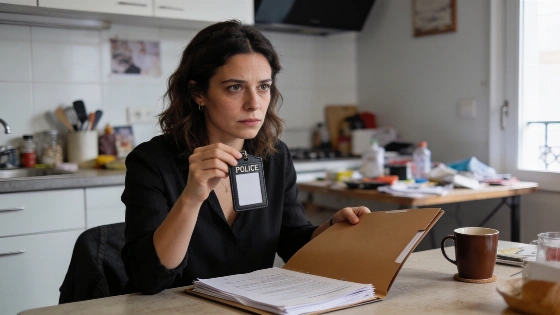
A Madrid woman discovered her husband was not a police officer but a skilled fraudster. Over ten years, he emptied her accounts, forged documents, and deceived family and friends. The case exposes legal gaps in marital fraud.
A Madrid woman’s life was upended after learning her husband, believed to be a National Police officer, had been living a lie for nearly a decade. The man, known as Rafa, convinced his wife, Patricia, and their circle that he worked in law enforcement, while secretly draining her finances and forging documents. The deception only came to light after friends and family began to notice inconsistencies, leading to a dramatic unraveling of his fabricated identity.
The couple met in 2010 through a dating app. Rafa claimed to be from Ubrique and working in Cádiz, later moving to Madrid for a supposed police transfer. He maintained the illusion by sharing staged photos, recounting stories from his ‘work’, and even arranging for fake salary deposits labeled as Ministry of Interior payments. Patricia, trusting her husband, allowed him to manage their joint finances, a decision that would later leave her with mounting debts and no access to her own accounts.
As the years passed, small irregularities began to surface. Cash went missing, rental payments were left unpaid, and explanations from Rafa grew increasingly convoluted. He manipulated digital conversations, used dual SIM cards to forge messages, and even falsified WhatsApp chats to cover his tracks. When confronted, he deflected blame or played the victim, deepening Patricia’s confusion and self-doubt. The couple even attended therapy, where Rafa dominated sessions and Patricia was left questioning her own sanity.
It was not until 2019 that the truth began to emerge. Friends with law enforcement backgrounds checked official records and found no trace of Rafa in any police database. A supposed government appointment document he had shared was revealed as a forgery. When confronted, Rafa disappeared, fleeing to Ubrique. Patricia, with the help of her lawyer and close friends, began to piece together the full extent of the fraud. She discovered that Rafa had removed her from bank accounts, taken out loans in her name, and left her business on the brink of collapse.
The legal process proved challenging. Spanish law does not recognize fraud between spouses as a criminal offense unless abuse or violence is involved, forcing Patricia to pursue civil claims. Ultimately, evidence was gathered to reclaim over €27,000, though the total losses are believed to be higher. The group of friends, calling themselves “Durmiendo con su enemigo,” coordinated efforts to warn others and collect proof, uncovering that Rafa had also targeted several of them with minor thefts.
Rafa was eventually arrested in Ubrique in May 2021 on charges of fraud, forgery, and misappropriation. Before trial, he agreed to repay Patricia the proven amount, but payments have been inconsistent. The psychological impact remains significant, with Patricia still facing reminders of her ex-husband’s actions. The case highlights the difficulties victims face when marital fraud is not recognized as a criminal matter, leaving many without full legal recourse.
Cases of deception and fraud within personal relationships are not isolated in Spain. Similar stories have surfaced in recent years, reflecting broader challenges in detecting and prosecuting such crimes. The legal gap regarding spousal fraud has prompted calls for reform, as current laws often leave victims without adequate protection. For context, Spanish police have also dealt with complex fraud cases in other sectors, such as the recent operation in Catalonia involving a kidnapped truck driver and missing cocaine, underscoring the evolving nature of fraud and deception in the country.
Spain’s legal framework continues to adapt to new forms of financial and personal fraud. While authorities have increased efforts to educate the public and improve detection, many cases still rely on victims and their networks to uncover wrongdoing. The experience of Patricia and her friends serves as a cautionary tale about trust, vigilance, and the importance of legal safeguards in personal relationships.