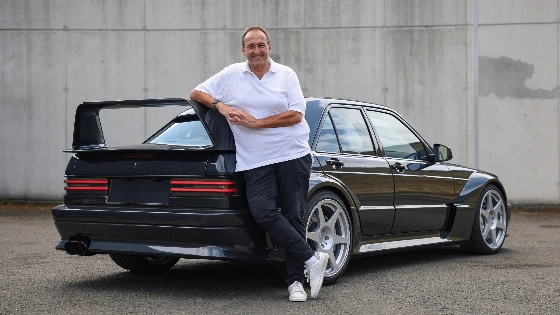
At the Nationales Automuseum The Loh Collection in Germany, the HWA 190 E 2.5-16 Evo II has returned as a restomod, bringing the 1990s icon into the modern era. Collector Friedhelm Loh, who owns both the first and last original Evo II models, took delivery of chassis 001, finished in 199 Blue-Black Metallic. HWA plans to build 100 examples, and the first reported private-customer delivery followed in July 2026.
Hans Werner Aufrecht, co-founder of AMG and one of the original Evo II’s creators, masterminded the limited run, linking the marque’s motorsport history with contemporary engineering. Three new HWA models now stand alongside the two classic black Evo IIs and Klaus Ludwig’s 1992 DTM-winning car, nearly indistinguishable from their ancestors at first glance. HWA, the Affalterbach-based motorsport specialist with a long history connected to Mercedes-Benz and AMG, has made the road-going Evo its first street car.
Modern Engineering, Classic Soul
Unlike a conventional restoration, the HWA Evo II substantially re-engineers the W201-based car. Its body is stripped and reinforced with carbon fiber, while a prominent rear wing echoes the original’s functional, homologation-era aerodynamics. The 1990-model-year Mercedes-Benz 190 E 2.5-16 Evolution II was built as a road-legal special to support the Deutsche Tourenwagen-Meisterschaft (DTM). Mercedes-Benz produced 502 examples, all but two in Blauschwarz, and equipped the car with a short-stroke, Cosworth-developed 2.5-liter four-cylinder engine and an adjustable aluminum rear wing.
The HWA replaces the original four-cylinder with a turbocharged 3.0-liter V6. The stated standard configuration produces 450 horsepower, with the Affalterbach package raising output to 500 hp. A separate published specification lists 444 hp, a six-speed manual gearbox and rear-wheel lead, with a weight of about 1,350 kg; the output figures refer to different stated configurations. The manual transmission and rear-wheel lead preserve a direct, driver-focused character, while the reworked chassis and discreet digital instruments add modern usability.
Inside, the car balances classic cues, including an original-style dashboard and analog switches, with contemporary touches. Supportive seats and four-point harnesses underline its motorsport character. A start button fires the engine, replacing the original’s four-cylinder soundtrack with the more forceful note of the turbocharged V6.
Performance That Redefines the Icon
The original Evo II was a serious performance car for its period. Manufacturer figures cited by Classic & Sports Car put its 0-60 mph time at 7.1 seconds and its top speed at 155 mph; it weighed approximately 1,340 kg and had a 2,664 mm wheelbase. Klaus Ludwig later drove an Evo II to the 1992 German Touring Car Championship title, cementing the model’s place in DTM history.
The new HWA version is described as delivering 0-100 km/h in 4.0 seconds and a top speed of 270 km/h, with a weight below 1,400 kg. Its turbocharged engine builds a surge of torque between 3,000 and 4,000 rpm. Despite the large performance increase, the car is designed to remain analog and direct, a deliberate contrast with the digital interfaces and electric powertrains increasingly common in modern performance cars.
HWA’s road-going Evo is distinct from the track-focused Evo R, a separate and more powerful model. The road car’s production cap of 100 is far below the original Evo II’s 502 examples, putting it firmly in the low-volume collector market. Published prices also vary by specification: the article gives a figure around €850,000, while another reported starting price is approximately €714,000. Friedhelm Loh has noted that these cars can seem almost too valuable to lead, although their engineering invites them onto winding country roads.
Exclusivity and Legacy
For collectors, the HWA Evo II combines a recognizable historic design with a contemporary powertrain and chassis. Its value reflects both its limited production and the original car’s competition legacy: oversized aerodynamic features were shaped by homologation and DTM requirements, and Ludwig’s 1992 championship added to the model’s standing. Loh, now more curator than driver, sees the cars as belonging in museums and private collections as much as on the open road.
The return of the Evo II reflects a wider automotive interest in reimagining historic models with modern engineering. Volkswagen’s latest Passat 2.0 TDI 4Motion, for example, blends familiar design values with contemporary comfort and efficiency. Volkswagen’s approach shows how legacy and progress can coexist, much like the philosophy behind the HWA Evo II.
As the automotive world moves toward electrification and digitalization, the HWA 190 E 2.5-16 Evo II makes a case for analog driving and mechanical craft. Limited to 100 cars, it carries the visual and cultural legacy of the original while replacing much of its mechanical package with modern hardware, an unusually direct bridge between a DTM homologation special and today’s collector-car market.