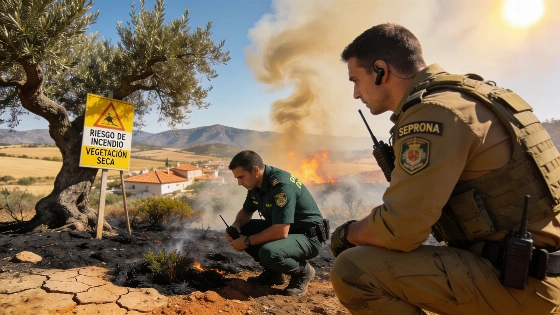
Authorities in Castellón have opened investigations into three men suspected of causing separate fires in the province, while the Guardia Civil steps up its campaign against forest-fire risks this summer. The cases, registered in June and July, have drawn attention because they occurred near populated areas and some may have been deliberate. Spain’s wildfire-prevention structure distinguishes fires set deliberately or through negligence from accidental fires.
The first incident occurred on June 13 in Soneja, where a nighttime blaze broke out on an agricultural plot near the town center. The fire affected around 45 square meters and alarmed local residents because it was close to homes. Investigators from the SEPRONA unit in Segorbe identified a 64-year-old man as the suspected perpetrator. Evidence suggests the fire was deliberately started with an incendiary substance. Authorities clarified that this incident is unrelated to another fire reported in Soneja on July 6.
In a separate case, SEPRONA officers from Castellón linked a 38-year-old man to an attempted forest fire on June 20 near kilometer 9.5 of the CV-190 road in Adzaneta. After inspecting the site, agents noted how close the fire was to forested land and how quickly it could spread. The man is under investigation for attempted arson.
The third investigation, led by SEPRONA in Sant Mateu, centers on a man suspected of starting a wildfire with an unauthorized bonfire. The Guardia Civil said the fire spread from the bonfire into a nearby forested area, prompting proceedings over the risk to public safety.
All three cases have been referred to the appropriate judicial authorities. Wildfire-related liability in Spain can involve administrative and civil consequences, with criminal proceedings also possible. The applicable administrative fine depends on the offense, the land classification, the damage caused and the relevant regional rules. A maximum of €600,000 is not a universal penalty for every fire. Criminal proceedings may also follow when conduct creates a serious fire risk, causes environmental damage or endangers people and property. Any penalties in these cases will depend on the findings and the legal process.
The investigations come during an exceptionally severe wildfire season nationally. At an October government briefing, Agriculture Minister Luis Planas said more than 270,000 hectares had been affected by fires in Spain during 2026, including about 60,000 hectares of agricultural land. Separately, the European Commission’s Copernicus wildfire monitoring system recorded 301,413 hectares burned in Spain between January 1 and October 21, representing 43% of the European Union total in that dataset. The figures use different monitoring and reporting methods. They are national totals, not estimates for Castellón or measures of the contribution of these three incidents. The government also approved €9 million in aid for agricultural holdings affected by the fires.
With temperatures rising and dry vegetation accumulating, wildfire risk in Spain peaks during the summer months. The Guardia Civil urges the public to avoid burning waste or lighting fires outside authorized areas. It also warns against discarding cigarettes or other flammable materials in or near forests. Residents are advised to report any signs of fire immediately to emergency services via 062 or 112.
SEPRONA maintains year-round surveillance and prevention efforts, stepping them up during the summer campaign in coordination with other environmental protection agencies. Its focus is on detecting fires early and responding quickly, while holding those responsible accountable. Figures from Andalusia show the wider prevention challenge: officials said more than 94% of fires during the high-risk campaign had a human origin. That category includes deliberate or negligent acts, as well as accidents. The figures do not describe Castellón, but point to the role of human behavior in wildfire prevention.
Recent events in Castellón echo broader concerns about wildfire management across Spain. In Almería, for example, authorities recently contained a major blaze in Los Gallardos, where victim identification and recovery efforts have been ongoing. For more on the response to large-scale fires in the country, see this report on how Andalusian officials handled the Los Gallardos incident.
Spain consistently ranks among the European countries most affected by wildfires, with thousands of hectares lost in severe seasons. Climate conditions compound risks from human activity, whether negligent or deliberate, making prevention and enforcement priorities for regional and national authorities. The investigations in Castellón illustrate the challenge of balancing rural land use with the need to protect communities and natural resources from fire hazards.