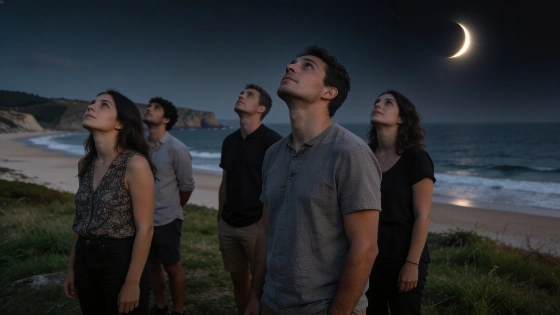
A total solar eclipse transformed the coastline of Esmelle and Ferrol on 12 August 2026, drawing crowds to beaches and balconies, while others watched from nearby hills as the Moon completely covered the Sun. For several seconds, an extraordinary silence swept over the area, broken only by the sudden quiet of birds retreating to their nests. The atmosphere shifted from anticipation to profound stillness as people watched the sky in awe, many visibly moved by the spectacle. The path of totality crossed northern Spain after passing over Greenland and Iceland, having begun over the Arctic. Much of Europe saw a partial eclipse, as did North Africa and the North Atlantic.
Observers described the moment as both physically intense and emotionally overwhelming. Some were brought to tears, while others gripped each other's hands or stood in silent amazement. The eclipse, the subject of much discussion and poetic speculation in the days leading up to the event, proved difficult to explain. Lautaro Herrera, one of those present, said the phenomenon felt far more physical than expected, leaving many struggling to articulate their reactions.
As the darkness passed and daylight returned, a common sentiment emerged: the desire to witness such a moment again. The event highlighted how rare it is to be alive to see nature express itself so dramatically, a feeling echoed by many along the Galician coast. The eclipse also sparked jokes and commentary, with memes circulating widely and people in the crowd calling for an encore after the Sun reappeared.
Just a week earlier, the beach at O Carreiro de San Vicente had offered another rare sight: the green flash, a phenomenon made famous by Julio Verne. A brief green line appears atop the setting Sun because of atmospheric refraction. These back-to-back natural events have fueled public fascination with celestial phenomena. Spain’s Centro Nacional de Información Geográfica (CNIG), part of the Instituto Geográfico Nacional, provided a dedicated portal for the eclipses visible from Spain in 2026, 2027 and 2028. Its maps show local visibility and maximum obscuration, as well as the duration of totality. Spain's growing focus as a destination for astronomical events, including the alignment of the Perseids meteor shower and a total solar eclipse in 2026, was previously highlighted in coverage of Spain's rare double event.
The eclipse also had a measurable short-term tourism impact. BBVA Research reported that foreign-traveler spending in Spain rose 13.8% year on year during the week of 10 to 16 August 2026, three percentage points faster than in the preceding two weeks. In provinces where the eclipse reached totality, in-person purchases made with foreign cards increased 25.7% year on year. Spending growth was particularly dynamic in Asturias and Cantabria, as well as Galicia and Aragón.
Galicia’s astronomical appeal was also linked to the broader “El cielo en el Camino” initiative in Fisterra, led by photographer Fernando Rey and involving local schools. The project connected astronomy with local heritage and educational work rooted in the field, presenting the eclipse and the Perseids as complementary attractions linked to the Camino de Santiago. Separately, the Instituto de Astrofísica de Canarias reported successful validation in Palencia of instrumentation designed to measure the solar corona, the Sun’s outer atmosphere, visible during totality when the bright solar disk is obscured.
Galicia's coastal setting offers a compelling place to observe celestial events, although visibility and the duration of totality vary by location. Total solar eclipses occur when the Moon fully covers the Sun from an observer’s viewpoint; outside the path of totality, the eclipse is partial. The green flash, while more common, still requires precise atmospheric conditions and a clear horizon. These events draw local residents, along with visitors and amateur astronomers from across Spain and beyond. The collective experience of silence and wonder during the eclipse has become a talking point in the region, reminding many of nature's unpredictable beauty and the fleeting chance to witness it firsthand.