Spain will witness the Perseids meteor shower at its peak under a moonless sky. The event coincides with a total solar eclipse on August 12. Experts expect ideal viewing conditions for both phenomena.
Spain is preparing for a rare astronomical event in August 2026, as the Perseids meteor shower will reach its maximum activity just hours after a total solar eclipse. According to the Instituto Geográfico Nacional (IGN), the peak of the Perseids is forecast between 4:00 and 6:00 a.m. on August 13, with strong meteor activity expected from late evening on August 12 through the following morning. This year, the spectacle is set apart by the near-perfect timing of the new moon, ensuring the sky will be free from lunar brightness and offering exceptional visibility for even the faintest meteors.
The unique overlap of these two phenomena is due to the fact that solar eclipses only occur during the new moon phase, when the Moon passes directly between the Earth and the Sun. In August 2026, the new moon will fall on the afternoon of the 12th, leaving the night sky almost completely dark for the Perseids. This absence of moonlight is a significant advantage for observers, as it removes one of the main obstacles to seeing the less luminous meteors that are often drowned out by a bright sky.
However, experts caution that a dark sky alone does not guarantee a spectacular show from every location. The actual number of meteors visible depends on local light pollution, weather conditions, and the observer’s field of view. The International Meteor Organization estimates a theoretical zenithal hourly rate of around 100 meteors per hour for the Perseids, but this figure assumes ideal conditions: a very dark sky, the radiant high above the horizon, and no obstructions. In practice, rural locations may yield 50–75 meteors per hour, while NASA suggests a more conservative 25 per hour under dark skies. For those seeking the best experience, traveling a few kilometers away from city lights can make a significant difference.
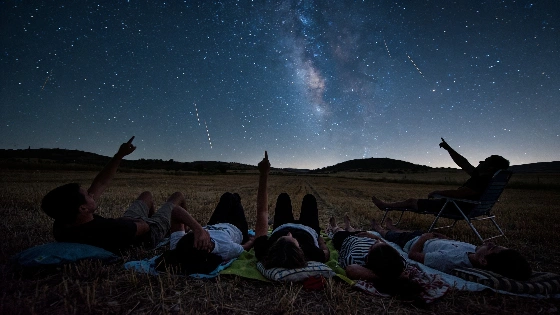
Throughout most of Spain, especially at latitudes near 40 degrees north, the Perseids’ radiant in the constellation Perseus remains above the horizon all night. Observers are advised to choose open, dark locations and to watch with the naked eye, as telescopes and binoculars restrict the field of view. Allowing about 20 minutes for eyes to adjust to the darkness and minimizing mobile phone use can further improve visibility. For comfort, a blanket or reclining chair is recommended, along with warm clothing for the cooler early hours.
The Perseids are not actual stars but the result of Earth passing through debris left by the comet 109P/Swift-Tuttle. As these particles enter the atmosphere at speeds close to 59 kilometers per second, they create the bright streaks commonly called shooting stars. The shower is named after the constellation Perseus, where the meteors’ paths appear to originate, though it is not necessary to look directly at Perseus to enjoy the display. The Perseids’ activity period extends from July 17 to August 24, with the most intense activity expected on the night of August 12–13.
Interest in the 2026 eclipse is already high, with many regions of Spain preparing for increased visitor numbers and special safety measures. As highlighted in recent coverage of eclipse safety protocols, such as Spain’s strict rules for eclipse viewing, authorities are emphasizing the importance of proper eye protection during the solar event. The combination of a total solar eclipse and a moonless Perseids night is a rare occurrence, making this August a landmark for astronomy enthusiasts and the general public alike.
For context, the Perseids are one of the most reliable and widely observed meteor showers in the northern hemisphere. The parent comet, Swift-Tuttle, completes an orbit around the Sun every 133 years, leaving a trail of particles that Earth encounters annually. While the Perseids are visible from mid-July to late August, the absence of moonlight in 2026 is expected to provide some of the best viewing conditions in recent memory. This alignment of astronomical events is not expected to repeat in the near future, underscoring the significance of this year’s spectacle for Spain and beyond.