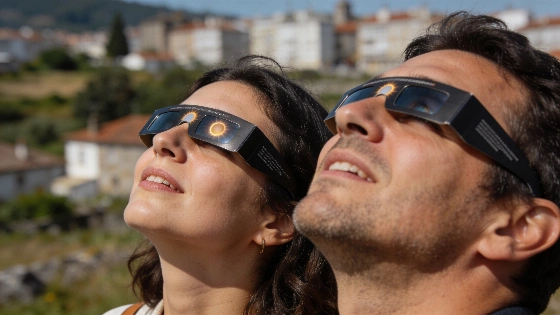
Spain prepares for a major solar eclipse with strict safety advice. Experts warn that removing protective glasses even for a second can cause serious eye injury. The rules differ sharply between total and partial eclipse zones.
As Spain braces for a rare solar eclipse, health authorities and astronomers are issuing urgent reminders about the dangers of looking at the Sun without proper protection. The surge in online searches for “me duelen los ojos” after the 2024 total eclipse in the United States highlighted widespread concern over eye safety. Even brief exposure to direct sunlight during an eclipse can cause solar retinopathy, a condition that damages the retina and may lead to blurred vision, color distortion, or a dark spot in the center of sight. Symptoms often appear hours after exposure, making prevention critical.
From the very start of the eclipse—expected around 19:30 in Galicia—anyone planning to observe the Sun must wear certified eclipse glasses. These glasses must remain on as long as any part of the solar disk is visible, no matter how small the sliver of light. The only exception is during the brief period of totality, when the Moon completely covers the Sun. In Galicia, this will occur at approximately 20:28, but only within the narrow path of totality. Depending on location, totality may last just a few seconds near the edges or over a minute and a half closer to the center. During this window, it is safe to remove the glasses and view the solar corona with the naked eye. The moment the first flash of sunlight reappears, glasses must be put back on immediately.
For those outside the path of totality, including many in Galicia who will experience up to 99.9% coverage, the rules are stricter. Even a tiny fraction of the Sun emits enough radiation to cause permanent eye damage. In these areas, eclipse glasses must never be removed while observing the event. The difference between 99% and 100% coverage is critical for safety. As noted in a recent report on Catalonia's eclipse preparations, local authorities are emphasizing strict adherence to these guidelines to prevent injuries.
Experts recommend setting a timer or alarm to signal the end of totality, especially in locations where the safe viewing period is extremely short. This precaution helps ensure glasses are replaced before the Sun reappears. Those who wear prescription glasses should keep them on and place eclipse glasses over them, as regular lenses offer no protection against solar radiation.
Only glasses that meet the ISO 12312-2 international standard and are purchased from reputable sources should be used. Damaged, scratched, or deteriorated glasses must be avoided, as they may fail to block harmful rays. Cloudy weather does not eliminate the risk—if the Sun is visible, even through clouds, protective glasses are still required.
Homemade solutions such as smoked glass, photographic negatives, or multiple sunglasses are not safe and can result in serious injury. If certified glasses are unavailable, indirect viewing methods—such as projecting the eclipse onto a surface—are the safest alternative.
Using telescopes or cameras is only safe if a dedicated solar filter is installed in front of the lens. Never use these devices without proper filters, and do not rely solely on eclipse glasses when looking through optical instruments, as concentrated sunlight can destroy the glasses and cause severe eye damage.
Solar eclipses are rare and spectacular, but the risks of improper viewing are real and irreversible. In Spain, the upcoming event has prompted widespread public information campaigns and coordination between health, education, and local authorities. The ISO 12312-2 standard is now widely recognized as the benchmark for safe eclipse glasses. In previous eclipses, cases of eye injury have been reported even among those who believed they were protected, often due to counterfeit or damaged glasses. The safest approach remains strict adherence to official guidelines and never looking directly at the Sun without certified protection, regardless of weather or eclipse coverage.