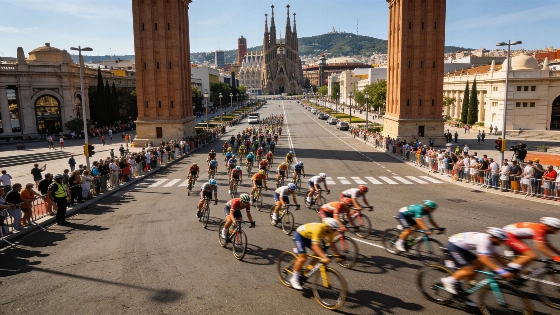
The 2026 Tour de France opened in Barcelona on 4 July with a 19.6-kilometre team time trial, the first stage of the race’s Grand Départ. The Barcelona-Barcelona test took teams through the city and finished atop Montjuïc, with the first yellow jersey at stake. Under the revised format, each rider’s finishing time counted individually; in previous editions, the team’s fourth rider set its official time. That change made the opening test a tactical challenge and a fight for early position.
The route was mostly flat for its first 16 kilometres, then rose over a 1.1-kilometre climb averaging 5.1%. After a short descent, riders faced a final 800-metre ramp to the Olympic Stadium at a 7% gradient. Support riders could set a high pace before dropping back, while team leaders had to manage the final ascent against the clock. The 19.6-kilometre team test was followed later in the race by 26.1 kilometres of individual time trials, giving the 2026 programme two distinct tests against the clock.
Visma won the opening team time trial in Barcelona, but the result did not settle the general-classification contest. Tadej Pogačar, leading UAE, went on to win stage 10. Jonas Vingegaard of Visma later lost time to Pogačar on the Tourmalet stage and crashed out on stage 15, when he was 4:30 behind. The race’s route included seven flat stages and four hilly stages, alongside eight mountain stages; five stages finished at the summit, including two at Alpe d’Huez. Richard Carapaz won stage 20, finishing at Alpe d’Huez in 4:59:39.
RTVE scheduled free live coverage of the opening stage on Teledeporte from 16:50 Spanish peninsular time, additional coverage on La 1 from 18:15 and streaming on RTVE Play. Carlos de Andrés and Pedro Delgado provided commentary. Teledeporte’s social media channels carried updates and highlights. RTVE.es/Deportes published stage reports.
Barcelona’s role as host of the Tour’s Grand Départ highlighted the city’s commitment to major international sporting events. In recent years it has also hosted competitions such as La Vuelta and the America’s Cup. The broader strategy to position Catalonia as a hub for global sport is discussed in this analysis of Catalonia's lead for international events. The Tour began in Barcelona on 4 July and concluded in Paris on 26 July, bringing global attention to the city and a major event to the region.
The 2026 route combined the opening team time trial with one individual time trial, alongside stages across varied terrain, including mountains. The Barcelona result gave teams an immediate test of coordination and speed, while the subsequent mountain stages and individual race against the clock offered further opportunities to reshape the standings. The opening stage set the competitive tone, but the race’s later results showed how much could still change over three weeks.