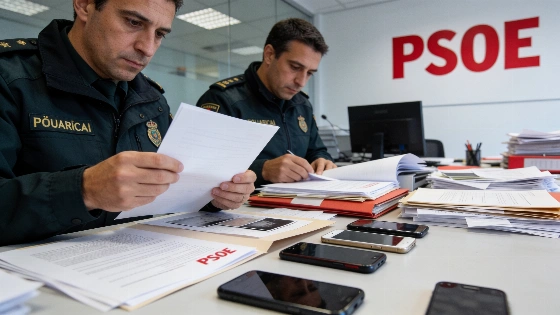
A Guardia Civil report claims Santos Cerdán enabled a criminal network within PSOE. Investigators suspect forged invoices and irregular payments involving senior party staff. The case raises new questions about internal controls.
The Unidad Central Operativa (UCO) of the Guardia Civil has directly implicated Santos Cerdán, a senior PSOE figure, in allegedly placing the party's organizational structure at the disposal of a criminal network. According to a report accessed by Antena 3 Noticias, investigators believe that key party officials may have facilitated irregular financial operations and covered them up through falsified documentation.
The UCO's findings are based on the analysis of mobile phone data from five individuals under investigation, including Juan Manuel Serrano, the former president of Correos. The report highlights what it calls a "significant" and "demonstrative" element: the way costs were covered and logistical needs met for the activities under scrutiny. This, the agents argue, points to a coordinated effort within the organization to support the alleged criminal scheme.
Central to the investigation is Ana María Fuentes, the current manager of PSOE. The UCO suspects that Fuentes, with the mediation of Leire Díez and under the direction of Santos Cerdán, was responsible for falsifying two professional engagement notes. These documents were reportedly created with two law firms linked to the network: ESTUDIO JURÍDICO l. OLIVER & PARTNERS SL (Ismael Oliver Romero) and Jacobo Teijelo. The report suggests these contracts were merely instrumental, designed to simulate a professional relationship and enable the party to make payments to both lawyers.
Investigators also mention Covadonga San Pedro, a PSOE secretary and administrative worker, as having played a supporting role by providing logistical and administrative assistance. Celia Rodríguez, another party employee, is described as having a similar function. The report characterizes the involvement of Fuentes, San Pedro, and Rodríguez as "essential" for managing the costs associated with the party's activities under investigation.
The UCO's document outlines the broader objective of the inquiry: to determine and quantify the actual costs assumed, the operations carried out to cover them, the individuals involved, and the extent of their knowledge about the activities. Despite the gravity of the allegations, PSOE headquarters at Ferraz continues to express confidence in the three named officials, maintaining that they acted under the instructions of Santos Cerdán and that all actions appeared to be legal at the time.
This case is part of a wider pattern of scrutiny facing Spanish political parties over financial practices and internal oversight. In a related development, María Jesús Montero recently distanced herself from the SEPI scandal, expressing regret over her trust in Vicente Fernández as the investigation into the Leire case expanded. For more on the growing pressure within PSOE leadership, see the coverage on Montero's response to the SEPI probe.
Spain has seen a series of high-profile investigations into political party finances in recent years, reflecting increased vigilance by law enforcement and judicial authorities. The UCO, as a specialized unit of the Guardia Civil, plays a central role in uncovering complex financial schemes and alleged corruption. While the current report does not constitute a judicial verdict, it signals ongoing concerns about transparency and accountability within major political organizations. The outcome of this investigation could have significant implications for internal party governance and public trust in Spain's political system.