London’s lamp posts now double as electric car chargers, easing urban charging woes. While Germany and Portugal expand similar solutions, Spain’s pilot in Valencia stalled, highlighting a growing infrastructure gap.
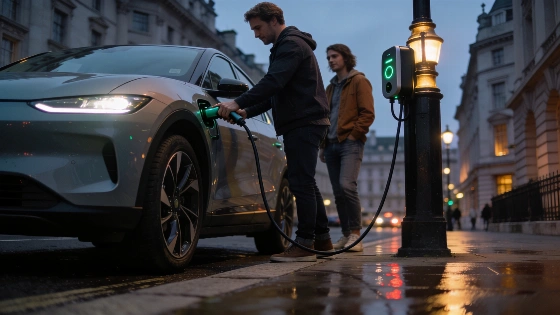
On Sutherland Avenue in London, a row of ordinary lamp posts has quietly become a symbol of urban adaptation. Here, drivers can plug in their electric vehicles directly at the curb, thanks to a project that has turned street lighting into a practical charging network. This approach, now spreading across the UK, Germany, and Portugal, is reshaping how cities tackle the challenge of charging electric cars for residents without private parking.
According to data cited by elespanol motor, around 70% of London’s vehicles are parked on public streets overnight. With electric car sales climbing—FACONAUTO reported a 5.8% rise to 916,609 units over four consecutive months in 2025—the need for accessible charging has become urgent. The lamp post solution offers up to 22 kW charging, using existing electrical infrastructure and requiring drivers to bring their own cables. The installations are discreet, blending into the streetscape without disrupting pedestrian flow or city aesthetics.
The first major rollout took place on Sutherland Avenue, which was even renamed “Electric Avenue W9” to mark the transformation. The project, a collaboration between Siemens, Ubitricity, and Westminster City Council, has since expanded into residential neighborhoods, providing a model for other European cities facing similar challenges.
Spain, however, has struggled to replicate this success. In 2021, Valencia launched a pilot with 22 lamp post chargers, but the initiative stalled due to regulatory and technical hurdles. Despite growing demand, the project was ultimately deemed unsuccessful, and the vision of widespread street charging remains distant for Spanish drivers.
Meanwhile, Spain’s public charging network is growing, but not without setbacks. The latest ANFAC Electromobility Barometer shows 56,682 public charging points as of the second quarter of 2026, up 2.9% from the previous period. Yet nearly a third—17,821 points—remain inactive, mainly due to delays in grid connection approvals. Most of the network consists of slower chargers (up to 22 kW), while high-power stations (250 kW or more) are still rare, with just 2,806 operational. Spain’s infrastructure score stands at 26.9 out of 100, well below the European average of 40.1, underscoring the gap in readiness for mass electric vehicle adoption.
As European cities race to modernize, the contrast is stark. While the UK and its partners move quickly to integrate charging into daily life, Spain’s progress is hampered by bureaucracy and technical inertia. The situation echoes broader trends in the automotive sector, where international expansion and innovation are reshaping the market. For example, the recent move by Chery Automobile to shift production to Barcelona with Ebro Motors, resulting in overseas revenue surpassing domestic sales, highlights how global strategies are influencing local realities. More on this shift can be found in the analysis of Chery’s expansion in Spain.
For now, the promise of charging your car at the nearest lamp post remains out of reach for most Spanish drivers. Whether Spain can overcome its regulatory and technical barriers will determine how quickly it can catch up with its European neighbors—and how soon its cities can offer the same level of convenience to electric vehicle owners.