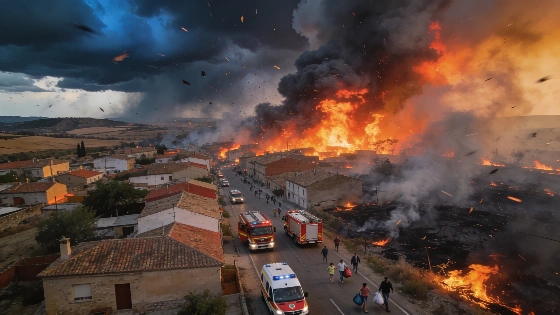
The Government of Aragón has ordered Uncastillo’s immediate evacuation, making it the fifth urban area in Zaragoza province forced to clear out as a wildfire sweeps through Cinco Villas. Announced just after 11 a.m. on Thursday, the decision comes as the fire remains uncontrolled and its cause has yet to be disclosed. It has already devastated more than 4,500 hectares, information from the regional Crisis Center.
Nearly 600 residents of Uncastillo received an ES-Alert as flames advanced dangerously close to the town. The evacuation is a preventive measure, but strong southern winds have complicated firefighting and raised the risk of the blaze spreading further. Aragón environmental officials also cited high temperatures and low humidity; frequent, sudden changes in wind direction have made suppression efforts harder.
Evacuees from Uncastillo are being transported to the Casino de Ejea de los Caballeros. There, 80 people from the previous day’s evacuations in Luesia and Asín are sheltering after spending the night in the local sports center, along with evacuees from Orés. All 40 elderly residents of the Uncastillo care home have also been moved to a facility in Zaragoza, joining around 100 seniors from other affected towns who were relocated on Wednesday.
The fire, later identified as the Orés fire, affected the municipalities of Orés, Asín, Ejea de los Caballeros, Luesia, Biota and Uncastillo in Zaragoza’s Cinco Villas comarca. The latest evacuation shows the scale of the emergency as authorities race to protect residents and vulnerable groups. Strong winds have made containment especially difficult, prompting rapid decisions and large-scale relocations. The situation in Zaragoza echoes recent wildfire emergencies elsewhere in Spain, including the Los Gallardos fire in Almería, where containment efforts and victim identification drew national attention. Details are available in this report on the Los Gallardos response.
Wildfires have become an increasingly frequent threat in Spain, particularly during periods of high temperatures and strong winds. The rapid mobilization of emergency services and the use of mass alert systems such as ES-Alert reflect changing strategies to safeguard communities. In Cinco Villas, the coordinated evacuation of multiple towns and care facilities shows the vulnerability of rural areas and the logistical challenges facing regional authorities.
By October, the response had shifted toward recovery as well as emergency management. Aragón officials described measures to limit soil erosion and support vegetation recovery, including small barriers in ravines and gullies alongside bundles of branches on slopes. They also spread straw over soil and shredded wood on site. Across Aragón, the 2026 fire season included five major forest fires and 35,675 hectares burned; the regional total covers multiple fires, not just the Orés blaze. An environmental official described the season as “extraordinarily complex.”
Recovery has also involved financial support. Aragón’s Department of Economy, Competitiveness and Employment reported 44 aid applications from affected small businesses and self-employed workers. The Orés-Cinco Villas area accounted for 18 applications, with €80,397.90 requested and €74,670.78 initially considered eligible. Separately, the Spanish Council of Ministers approved €9 million in aid for agricultural holdings affected by the 2026 fires. The CNMC recorded the regional compensation scheme under file AE/CNMC/054/26, linked to European state-aid number SA.125095.
As the fire continues to burn, the immediate focus remains on protecting lives and preventing further destruction. The longer task is restoring affected land and helping communities recover. The cause of the initial outbreak in Orés remains under investigation.