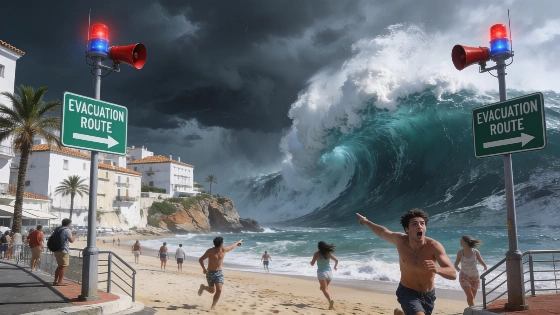
UNESCO has issued a stark warning: a tsunami of at least one meter is virtually guaranteed to hit the Mediterranean within the next 30 to 50 years. Spain is among the countries advised to maintain robust coastal warning and prevention systems.
UNESCO has sounded an urgent alarm for countries bordering the Mediterranean: a tsunami of at least one meter in height is not just possible, but inevitable within the next three to five decades. The warning, based on decades of seismic and oceanographic data, places Spain among the nations that must keep their coastal alert and prevention systems fully operational.
The Intergovernmental Oceanographic Commission of UNESCO has highlighted that the Mediterranean, often seen as a calm sea, is in fact vulnerable to tsunamis triggered by underwater earthquakes, volcanic eruptions, or landslides. While the Pacific and Indian Oceans are more commonly associated with such disasters, the Mediterranean’s densely populated coastlines, busy ports, and thriving tourism make even a relatively small tsunami potentially devastating.
Hidden Dangers in a Tranquil Sea
Since 1840, about 10% of all recorded tsunamis have occurred in the Mediterranean, according to UNESCO. The rarity of these events does not diminish their impact: the region’s urbanized shores and critical infrastructure mean that even a one-meter wave can cause severe flooding, strong currents, and significant damage to harbors and coastal communities.
Experts caution that the first wave is not always the most dangerous. Tsunamis can arrive in a series, with powerful currents capable of sweeping away people, boats, and vehicles. The Mediterranean’s compact geography leaves little time to react—waves can reach the nearest coast in as little as 20 to 40 minutes after an event is detected.
High-Risk Zones: Eastern Mediterranean in Focus
The eastern Mediterranean is considered the most exposed area due to intense tectonic activity. Greece, particularly Crete, the Hellenic Arc, and the Aegean Sea, sits at the intersection of the African and Eurasian plates, making it especially vulnerable. Southern Italy, including Sicily, the Strait of Messina, and areas near Mount Etna, also face heightened risk. In Turkey, the western Aegean coast, with cities like Izmir and Bodrum, is closely monitored for seismic threats.
While the western Mediterranean is less prone to tsunamis, the risk is not negligible. In Spain, the national civil protection plan identifies the Balearic Islands, Valencia, Catalonia, Murcia, Andalusia, Ceuta, and Melilla as regions requiring ongoing vigilance and preparedness.
Spain’s Response: Rapid Alerts and Public Education
Spain operates a National Tsunami Warning System, integrated into the broader National Alert Network. This system combines the resources of the National Seismic Network, tide gauges managed by Puertos del Estado, and other marine detection technologies. However, the short warning times in the Mediterranean mean that technical detection alone is not enough. Public education, regular evacuation drills, and clear signage for escape routes are essential to minimize casualties and damage.
Spanish Civil Protection authorities have already participated in international early warning exercises, such as the Neamwave21 drill, which tested coordination between international centers, national agencies, and regional emergency services in scenarios affecting Valencia and Andalusia.
Preparation Saves Lives
UNESCO emphasizes that preparedness is the most effective defense against tsunamis. While the Mediterranean is not under immediate threat, the certainty of future events demands updated emergency plans, institutional coordination, and a population capable of recognizing natural warning signs—such as strong earthquakes or sudden sea withdrawal.
For context, the Mediterranean’s unique geography and high population density make it particularly sensitive to even moderate tsunamis. As climate change and coastal development continue, the importance of robust prevention and rapid response systems will only grow.