The US will increase its military presence in Spain with a sixth Arleigh Burke-class destroyer and 300 additional personnel at Rota. This comes as the Pentagon reduces forces elsewhere in Europe, highlighting Spain's growing strategic role.
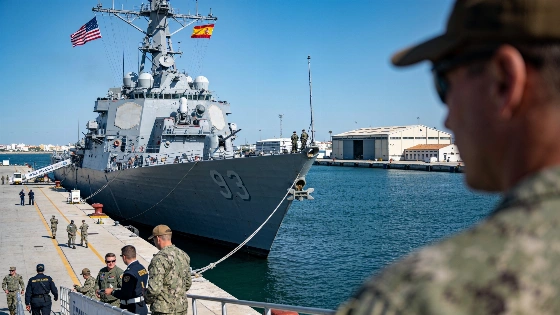
The United States is set to expand its military footprint at the Rota Naval Base in Cádiz, with the arrival of a sixth Arleigh Burke-class destroyer and an additional 300 US Navy personnel after the summer. This move stands out as the Pentagon continues to scale back its troop numbers in other parts of Europe, including Germany, signaling a shift in strategic priorities that places greater emphasis on Spain’s role within NATO operations.
According to Spain’s Ministry of Defence, the new destroyer will join the existing fleet at Rota, which already hosts five US Navy ships as part of the Forward Deployed Naval Forces-Europe (FNDF-E). The latest vessel, an advanced Flight III variant equipped with the AN/SPY-6 radar system, will enhance the base’s capabilities, offering improved detection of smaller and more distant targets compared to previous models. The arrival of this ship had been delayed for operational reasons, as the US Navy prioritized deploying the most modern technology available.
The deployment is expected to be a key topic in the upcoming meeting between Spain’s Defence Minister, Margarita Robles, and the US ambassador in Madrid, Benjamín León Jr. The original agreement for four destroyers at Rota dates back to 2011, with an expansion to six ships formalized in May 2023. In recent years, the older vessels have been replaced by newer models, each equipped with onboard helicopters to further boost operational flexibility.
Significant investment has accompanied the expansion at Rota. Over €400 million has been allocated to upgrade the base’s infrastructure, with Spain covering around €250 million of the costs, though some funding may be sourced from NATO infrastructure programs. Upgrades include expanded docking facilities to accommodate the sixth US destroyer and Spain’s new F-110 frigates, new hangars for helicopters and transport aircraft, a photovoltaic solar plant, logistics warehouses, fuel depots, and new accommodation for US personnel and their families. The base currently hosts approximately 7,000 US military members.
Despite recent tensions in diplomatic rhetoric between the US and Spain—highlighted by conflicting statements from former President Donald Trump during a NATO summit—the military relationship has remained stable and focused on operational needs. The Spanish government believes that the ongoing investments at Rota, including those funded by the Pentagon, make it unlikely that the base will be affected by broader US troop reductions in Europe.
While the six destroyers at Rota form the naval component of NATO’s missile defense shield against threats from Russia, Iran, or North Korea, their primary function for the Pentagon is strategic deployment in the Middle East. During recent Iranian retaliatory attacks, these ships were positioned in the eastern Mediterranean to provide missile defense coverage for Israel, using their Aegis systems to intercept projectiles launched from Tehran. This is not the first time Rota-based destroyers have played a defensive role in regional conflicts.
Although Spain has prohibited the use of Rota and Morón bases for logistical support in airstrikes against Iran, it has not objected to the deployment of US destroyers for defensive missions. This nuanced position reflects Spain’s commitment to NATO obligations while maintaining certain limits on direct involvement in offensive operations.
Rota Naval Base, located in the Bay of Cádiz, has been a cornerstone of US-Spanish military cooperation since the 1950s. Its strategic location allows rapid access to the Mediterranean, Atlantic, and North Africa, making it a critical hub for both NATO and US operations. The ongoing expansion and modernization of the base underscore its growing importance in the evolving security landscape of southern Europe and the broader Mediterranean region.