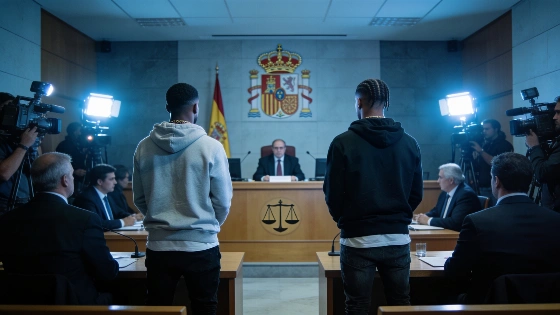
The Provincial Court of Valencia has cleared Madrid rapper El Jincho of sexual assault charges involving a minor with a disability. The verdict cites contradictions in the victim’s statements and lack of evidence.
The Provincial Court of Valencia has acquitted Madrid rapper David Calvo Villa, known as El Jincho, of charges related to the alleged sexual assault of a 17-year-old girl with a 41% disability after a concert in Mislata in 2023. The court also cleared Osiris El Enemy, the second artist accused in the case, following a detailed review of the evidence and testimonies.
Judges found that the case was marked by significant inconsistencies in the victim’s statements, particularly regarding the location of the alleged assault. The initial account given to police differed sharply from the version provided to forensic experts, with conflicting details about whether the incident took place in one hotel room or in two separate rooms on different floors. This discrepancy, according to the court, undermined the reliability of the narrative.
Testimony from the victim’s friend, who was present in one of the rooms, further complicated the prosecution’s case. She stated during the trial that she did not witness any act of sexual violence or anything she considered serious. Additionally, the hotel receptionist described the girl’s behavior as normal when she interacted with him after the alleged incident, noting that she did not request help or show signs of distress.
The court emphasized that, while it is not possible to predict how a person might react after a traumatic event, the objective behavior observed in this case raised questions about the coherence of the reported sequence of events. Surveillance footage from the hotel also played a role in the verdict, as it showed no visible signs of coercion or violence when the girl and the two men entered or left the premises. Furthermore, messages sent by the complainant to one of the artists hours after the incident, expressing interest in traveling to Madrid, were considered by the judges as additional evidence casting doubt on the prosecution’s version.
Another key point was the uncertainty over whether the accused were aware of the girl’s age. The court noted that her presence in the VIP area of the concert was unusual for a minor, making it unclear if the artists could have known she was underage. The prosecution had sought a 13-year prison sentence for El Jincho, but the court ultimately ruled that the existence of reasonable doubt required acquittal for both defendants.
The verdict is not final and may be appealed. This case highlights the complexities involved in high-profile legal proceedings where evidence is contested and public attention is intense. Similar debates over judicial decisions have arisen in Spain in recent years, such as the controversy surrounding the suspension of Víctor de Aldama’s sentence in a major corruption case, which drew scrutiny over the balance between legal rigor and public perception (see more on the Aldama case here).
Spain’s legal system requires that any doubt in criminal proceedings be resolved in favor of the accused, a principle that played a decisive role in this outcome. The case also underscores the importance of consistent testimony and objective evidence in securing convictions, especially in sensitive cases involving minors and individuals with disabilities. As the legal process continues, the possibility of an appeal remains open, and the case will likely continue to attract public and media attention.