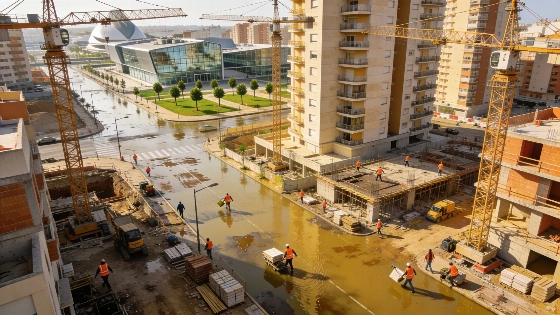
Valencia authorities have signed a protocol to rebuild La Torre after the 2024 floods. The plan includes 1,206 public housing units and new public facilities. Strict safety standards and faster procedures are key features.
Valencia’s regional and city governments have agreed on a sweeping reconstruction plan for La Torre, the district hardest hit by the October 2024 floods. The protocol, signed by Generalitat president Juanfran Pérez Llorca and Valencia mayor María José Catalá, sets in motion a Special Urban Reconstruction Plan (PEUR) that will deliver 1,206 public housing units and 7,000 square meters of new public infrastructure.
The initiative responds to two urgent priorities: repairing flood damage and expanding access to affordable housing. Of the new homes, 981 will be available for purchase and 225 for affordable rent, aiming to support families affected by the disaster and address the broader housing shortage in the metropolitan area.
Authorities emphasize that the new buildings will be constructed to higher safety standards. All homes will be elevated to improve resilience against future floods, and no underground parking will be included. The PEUR mechanism, introduced under the Generalitat’s 2025 emergency urban planning law, is designed to accelerate recovery by streamlining land development and permitting processes, bypassing the slower procedures of general urban plans.
Pérez Llorca highlighted the speed and efficiency of the regional administration’s response, contrasting it with the national government’s slower pace. He called for reforms to Spain’s contract and local government laws, noting that only about 5% of the €1.7 billion transferred by Madrid for reconstruction has been spent so far. In contrast, the Generalitat claims to have completed 90% of its required civil works and launched all relevant initiatives under its Pla Endavant program.
Vice President Vicente Martínez Mus described the La Torre plan as an opportunity to introduce climate adaptation measures into local urbanism, tackle structural barriers to housing access, and stimulate economic and social renewal in the area. Mayor Catalá stressed that both administrations are committed to expanding housing opportunities and building a stronger, safer neighborhood, not just restoring what was lost. The city has already invested over €30 million in renewing drainage, roads, lighting, and community facilities in La Torre.
The PEUR for La Torre is part of a broader push by the Generalitat to develop public housing across the region, including through its Plan Vive. The approach mirrors efforts in other Spanish cities to address housing and urban resilience, as seen in the ongoing debate over tourist apartment growth in Barcelona’s Eixample and Gràcia districts, where authorities have struggled to enforce license freezes despite rising numbers of rentals. For more on the challenges of urban housing policy in Spain, see this analysis of Barcelona’s tourist apartment surge.
La Torre’s reconstruction is expected to set a precedent for how Spanish municipalities can respond to climate-driven disasters while addressing chronic housing needs. The use of expedited planning tools and stricter safety criteria reflects a shift in urban policy, aiming to make vulnerable neighborhoods more resilient and livable in the face of future emergencies. As climate risks and housing pressures grow, the outcomes in La Torre may influence similar initiatives across Spain.