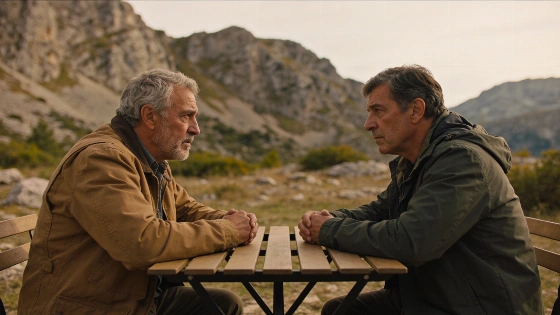
Fernando Garrido and Josemi Latasa meet for the first time since the ETA attack that destroyed Garrido’s family. Their conversation, broadcast by Salvados, lays bare the scars left by violence and the search for accountability.
Nearly forty years after an ETA bombing tore apart his family, Fernando Garrido sat face to face with Josemi Latasa, one of the men involved in the attack that killed Garrido’s parents and brother. The meeting, arranged by Salvados, ended decades of silence and forced both men to confront what happened in 1986.
The program’s cameras captured the tension in the room and the long road that led there. Garrido, who survived only because he missed the car ride that day, has lived with the consequences ever since. Latasa, once a committed ETA member, drove the motorcycle used to plant the bomb under the official car of Rafael Garrido, then governor of Guipúzcoa. The attack left Fernando with a life marked by loss and questions that never faded.
The attack on the Garrido family took place on October 25, 1986, at the intersection of Boulevard and Legazpi in San Sebastián, when two ETA members on a motorcycle attached an explosive device to the car.
Years later, Latasa wrote to Garrido. In his letter, he expressed remorse and a need to apologize, but made it clear he did not expect forgiveness. Garrido, moved by the honesty of the message, recognized the courage it took to reach out. That letter became the first step toward the meeting now shown to a national audience.
Latasa’s break with ETA was slow and dangerous. He describes how the murder of his neighbor Yoyes, herself a former ETA member killed by the group, made him question his loyalty. Eventually, Latasa became one of the first to publicly denounce ETA’s violence, accept prison, and call for an end to the killings. His decision made him a traitor in the eyes of his former comrades, and ETA even sentenced him to death.
Salvados filmed the interviews in a remote mountain location, underlining the isolation and weight of the moment. The program reconstructs the events of 1986 through parallel interviews, showing how both men’s lives were shaped by the attack and what followed. The focus is not just on the crime, but on the lasting wounds and the slow, uncertain process of trying to repair them.
According to laSexta and Atresmedia, the episode 'El encuentro' was designed to highlight not only the crime but also the process of reconciliation, with parallel interviews exploring trauma, responsibility, and the long journey toward a possible meeting. The broadcast coincides with the 40th anniversary of both the Garrido family attack and the murder of Yoyes, as well as 15 years since ETA announced the end of its armed activity.
Although ETA officially disbanded in 2018, the pain remains for those directly affected. Meetings like this are rare in Spanish media, where victims and perpetrators almost never speak face to face. The broadcast comes as Spain continues to reckon with the legacy of ETA’s decades of violence, as seen in recent national acts of remembrance.
This televised meeting does not offer reconciliation, but instead exposes pain, regret, and the limits of forgiveness. Garrido’s willingness to listen, and Latasa’s acceptance of responsibility without asking for absolution, create a rare moment of public reckoning. In a country where the scars of political violence are still visible, Salvados has opened a difficult but necessary conversation about memory, accountability, and justice. By putting victim and perpetrator in direct dialogue, the program moves beyond slogans and forces Spain to face its past, one story at a time.