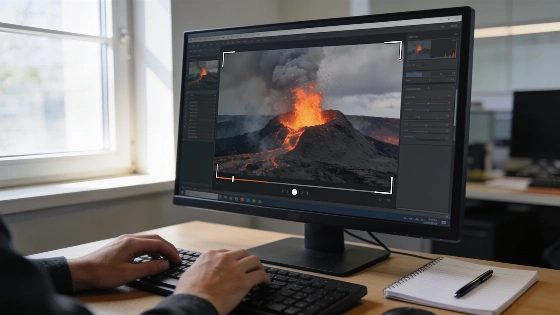
A video widely circulated as evidence of Anak Krakatoa erupting was actually made with artificial intelligence. The real eruption happened at night and looked nothing like the viral clip.
A video claiming to show Indonesia’s Anak Krakatoa volcano erupting spread quickly across social media, but it turns out the footage was created with AI tools. The clip, which was shared thousands of times on X, Facebook, Instagram, and YouTube, was widely assumed to show the recent eruption in the region. Closer examination, however, revealed it was a digital fake, not a real record of the event.
The timing helped the video go viral: Anak Krakatoa did erupt in the early hours of Sunday, September 6, according to Indonesia’s official MAGMA system. But the video shows a daytime eruption, which immediately raised questions. The volcano in the clip also appears much closer to a town than the real Anak Krakatoa, which sits alone in the Sunda Strait, far from any city.
According to Indonesia’s Geological Agency, a series of eruptions with lava fountains began on September 4, 2026, at 23:00 and ceased on September 6 at 00:04 WIB, explaining the heightened public attention during these days.
Several details in the video don’t add up. The lava is too bright and blends oddly with the smoke, unlike real eruptions where lava and smoke appear separately. The volcano looks oversized compared to the supposed town, and the lighting on buildings and cars never changes, as if the scene is frozen. The footage is too clean and polished, missing the messiness and shifting colors of real disaster videos.
Major news agencies like EFE, Associated Press, and France 24 published genuine images and video from the actual eruption. None matched the viral clip. The real eruption forced seven airports to close, including Jakarta’s main airport, and disrupted travel for 270,000 passengers because of volcanic ash. The real consequences were very different from the spectacle shown in the AI-generated video.
Technical checks confirmed the video was fake. Hive Moderation, an AI detection service, analyzed the clip and found with 98.9% certainty that it was generated by artificial intelligence. This matches the visual evidence and the mismatch in timing and location.
Reuters and AP reported that, at various points during the first 24 hours after the eruption, as many as eight airports were closed—including both Jakarta Soekarno-Hatta and Halim Perdanakusuma. By September 8, Indonesia’s Ministry of Transport confirmed that volcanic ash had affected 2,961 flights and approximately 341,000 passengers, a significant increase over earlier estimates.
The spread of convincing fake videos like this one is a growing problem for both the public and authorities. When AI-generated clips can look so real, misinformation can spread quickly—especially during emergencies when people need accurate updates. In this case, the real Anak Krakatoa eruption had serious effects on air travel and safety, but the viral video gave a false impression of what happened and where.
As AI tools become easier to use, both newsrooms and the public will need to check visual content more carefully. The quick exposure of this fake eruption video shows that careful review and technical analysis are essential. In a time when digital fakes can spread faster than facts, staying alert is the only way to avoid being misled.