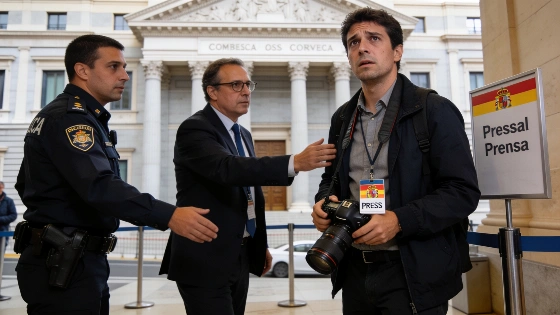
The governing board of the Spanish Congress has opened three additional disciplinary proceedings against Vito Quiles, raising the prospect that he could be permanently barred from parliamentary press activities. The chamber’s legal advisers cite repeated serious breaches of conduct, including disrupting a press conference by socialist spokesperson Patxi López and sharing images recorded in restricted areas of the building.
The legal assessment describes this pattern of behavior as a deliberate attempt to disrupt the normal functioning of Congress. The advisers argue that the violations affect lawmakers and undermine the work of other accredited journalists, with consequences for the institution itself. The files, received on Wednesday, say the repeated infractions could be reclassified as “very serious” under Article 98 of the chamber’s regulations, potentially leading to the definitive withdrawal of Quiles’s press credentials.
Under current rules, serious violations can bring suspensions ranging from eleven days to three months. Very serious cases may lead to suspensions of up to three years or permanent revocation. Quiles will be formally notified of the new disciplinary actions and will have an chance to submit his defense within a period usually set at between ten days and two weeks. The board will make the final decision on whether to impose an indefinite suspension.
The board is also reviewing a disciplinary file concerning Bertrand Ndongo, another far-right activist. Ndongo is accused of breaking protocol during a press appearance by Podemos spokesperson Ione Belarra on April 14, prompting a verbal confrontation. A one-month suspension for a serious violation has been proposed in his case.
Quiles and Ndongo have both had their accreditations suspended since May 13, pending the resolution of more than a dozen open cases. Two weeks after the initial suspension, the board extended Quiles’s ban to three months for recording and sharing images of former president José Luis Rodríguez Zapatero in a restricted area last December. The penalty was later increased to four months in July.
The tighter disciplinary measures in Congress come as the institution seeks to reinforce order and transparency. In recent months, parliamentary conduct and press access have faced increased scrutiny. The government has also moved to establish a mandatory public register for lobbying groups, bypassing legislative deadlock. For further context on these transparency initiatives, see the report on the government’s decree creating a public lobby register.
Congressional press accreditation helps ensure access and accountability in Spain’s legislative process. The current disciplinary actions reflect the chamber’s stated commitment to professional standards among accredited journalists and the integrity of parliamentary proceedings. The outcome of the cases may set a precedent for future enforcement of conduct rules within the institution.