
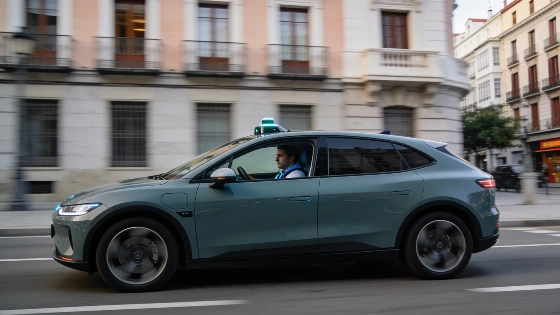
Waymo and Uber are preparing Madrid trials, but neither has estimated the effect on Spanish driving jobs. Waymo expects paid rides through its app from 2027, without confirming a launch date or fleet size.
Waymo will introduce fully autonomous operation in Madrid only in the third stage of its programme, after manual driving and supervised trials. Neither Waymo nor Uber has published an estimate of the effect on employment in Spain. Waymo announced its Madrid-region expansion on 20 October 2026, marking its first presence in Spain and its second region in the European Union.
Testing is due to begin in the coming days with Jaguar I-PACE electric vehicles. In the first stage, specialists will get behind the wheel so the technology can learn local traffic patterns. They will also observe how pedestrians move, while including cyclists in the data collection. Waymo says the programme is designed to adapt its system to local traffic rules and the behaviour of people using the roads.
In the next stage, the vehicle will drive itself with a trained local validation driver aboard to monitor the system and take control if needed. Full autonomy comes only in the third phase. Waymo says testing on public roads will follow the guidelines of Spain’s Directorate-General for Traffic (DGT) and all applicable regulations. Human staff, including workers with specific technical skills, will therefore remain part of much of the process.
The trials will take place across the Madrid region, including Madrid city, Alcobendas and Getafe.
Waymo plans to welcome its first riders in 2027, but has not given an exact launch date. It has disclosed neither its planned fare nor the size of its Madrid-region fleet, and has not named other Spanish regions where it intends to operate. The company’s 2027 target is a plan for passenger service; testing approval and commercial passenger-operation permissions are separate regulatory steps.
For local motorists, robotaxis are one of several changes to the driving environment. Other car news in Spain has also covered disruption affecting vehicles. The employment impact of autonomous services remains a separate question.
In September 2026, the DGT issued its first national permits for autonomous-vehicle testing to Uber and Chinese company WeRide, according to Reuters. Uber’s Madrid trials, conducted with WeRide, are expected late this year and will include mapping areas and validating routes. The company has not set a date for commercial service. Reuters reported that commercial services from Uber and WeRide were expected in Madrid by the end of 2026.
WeRide’s initial Madrid deployment comprises 20 GXR vehicles with a safety operator aboard, according to Expansión. The trials began in the Hortaleza and Arturo Soria districts, where the cars use cameras and other sensors to collect data. The regional authorities approved an initial deployment that could eventually include up to 100 robotaxis.
The scale of Waymo’s US operation offers context, though it does not show how quickly the service will expand in Spain. Reuters reported that the company runs more than 4,000 electric vehicles across more than 15 US cities. Waymo provides over 500,000 paid rides a week, and its vehicles operate around the clock.
In Europe, London is expected to be the first city with operational cars, before the end of the year. Munich and Madrid are next on the stated plan. Waymo has described Madrid as its second region in the European Union.
Waymo says its vehicles have 20 times fewer serious accidents than the average. The company has also recalled thousands of cars over a software problem in roadworks areas. During San Francisco’s December 2025 blackout, its fleet stopped and disrupted traffic.