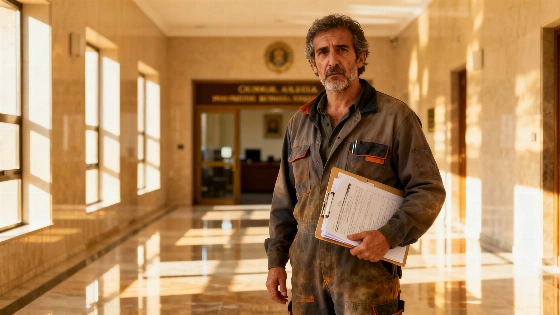
Court Upholds Denial of Pension for Canary Islands Plumber After Surgeries. A plumber from the Canary Islands failed to obtain recognition of permanent incapacity following serious injuries and surgeries. The court concluded that his condition is stable and does not prevent him from continuing to work in his profession.
The question of when injuries and chronic illnesses become grounds for receiving a disability pension remains one of the most pressing issues for many workers in Spain. The story of a plumber from the Canary Islands, who sought recognition of permanent disability after a series of serious surgeries, clearly illustrates how complex this process can be.
The man, born in 1967, applied to the Instituto Nacional de la Seguridad Social (INSS) in the summer of 2021. He requested to be recognized as fully unfit for his profession and to be granted a pension based on a contribution base of €1,046.49. His application listed serious medical problems: partial vision loss in his left eye, open fractures of the tibia and radius, severe osteoarthritis of the left ankle and elbow, as well as the aftermath of retinal detachment surgery performed in March 2023.
Plaintiff’s arguments
In his application, the plumber insisted that his condition showed no significant improvement, and that the ongoing limitations were not properly considered during the assessment. He emphasized that osteoarthritis and the consequences of the fractures pose a high risk of infection and could lead to complete loss of mobility, which he believes makes it impossible to continue working in his profession.
Court’s position
However, the judicial panel that reviewed his appeal relied on medical reports provided by the INSS. These reports indicated that, despite the presence of persistent impairments, none of them resulted in a complete and irreversible loss of work capacity. Specifically, his visual acuity was 0.1 in the left eye and 1.2 in the right eye, which, according to experts, does not prevent him from performing the professional duties of a plumber.
As for the fractures and surgeries on his leg, ankle, and arm, doctors considered their consequences to be clinically stable. The court found no signs of deterioration that could serve as a basis for recognizing total incapacity. The decision specifically emphasized that over the past year no new medical documents had been submitted indicating any worsening of vision or musculoskeletal condition.
Profession and Requirements
The key point for the court was the specific nature of the profession. The decision states that working as a plumber does not require binocular vision, so even partial loss of vision in one eye cannot be considered sufficient grounds for granting a disability pension. The court upheld the conclusions of the Equipo de Valoración de Incapacidades (EVI), finding no reason to revise them.
As a result, the Tribunal Superior de Justicia de Canarias upheld the INSS’s refusal to recognize permanent disability and to grant the corresponding pension. As noted by Talent24h, this case illustrates how strictly the courts assess medical limitations and their impact on professional activity.
Context and trends
The situation with the refusal to recognize disability for workers with chronic injuries and illnesses is not unique to Spain. In recent years, the rules and criteria for evaluating such cases have become increasingly detailed. For many applicants, the key factor is not just the presence of medical diagnoses, but their actual impact on the ability to perform specific job duties. A detailed analysis of the changes in approaches to recognizing permanent disability can be found in the article on the new rules for obtaining disability status in Spain.