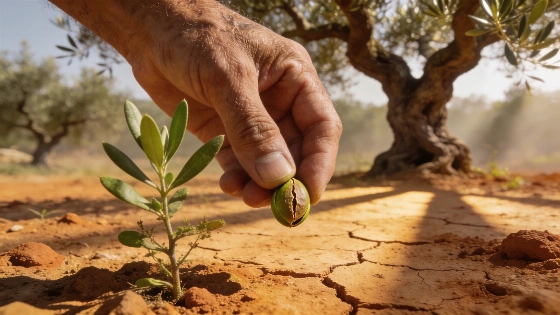
Planting an olive pit does not yield a cultivated olive tree, but instead produces a wild ancestor known as the acebuche. Classical scholar Rafael Fontán explains the science and history behind this Mediterranean tradition, challenging a common misconception.
When Rafael Fontán Barreiro, a classical culture professor and author of La almazara de Catón. Olivos y aceite en Grecia y Roma, is asked about growing olive trees from pits, his answer is both simple and surprising: “If you plant an olive pit, you won’t get an olive tree. You’ll get an acebuche.” The acebuche is the wild olive, the original species that has grown around the Mediterranean for millennia.
Fontán’s insight, shared in an interview with La Vanguardia, cuts through a widespread myth. While many assume that planting an olive pit will eventually yield a tree like those seen in Spanish groves, the reality is that the resulting plant reverts to its wild form. The cultivated olive, with its larger fruit and higher oil yield, is the product of thousands of years of human selection, grafting, and careful propagation.
The Science Behind the Acebuche
According to Fontán, the process is rooted in genetics. The seed inside an olive carries the traits of its wild ancestors. When planted, it “returns to the origin,” producing a hardy, thorny shrub rather than the familiar, productive olive tree. The domestication of the olive began around 8,000 years ago, with ancient farmers selecting and grafting the best specimens. The Phoenicians later brought cultivated olive cuttings to the Iberian Peninsula, trading them for tin in Tartessos.
To grow a true olive tree, Fontán explains, one must use cuttings or grafts from existing cultivated varieties. These are the descendants of ancient grafts, ensuring the continuity of the olive’s desirable traits. “Every olive tree is 7,000 years old,” he notes, emphasizing the unbroken lineage that connects today’s groves to their prehistoric origins.
How to Grow Olives Successfully
Fontán also shares practical advice drawn from classical sources. Olive trees thrive in porous soils with minimal clay and good drainage, as waterlogged roots can be fatal. Ancient treatises recommended spacing trees about nine meters apart, a practice that allowed groves to resemble shaded woodlands rather than the tightly pruned plantations common today.
Pruning, Fontán observes, has become more aggressive over time to boost fruit production, but in antiquity, trees were left to grow more naturally. The ideal climate for olives is mild, with ancient texts placing groves at low elevations near the coast. While modern techniques have expanded the olive’s range, these traditional guidelines still inform successful cultivation.
Olives in Mediterranean Culture
In La almazara de Catón, published by Godall Edicions, Fontán explores the olive’s role in Greek and Roman agriculture through the writings of Theophrastus, Virgil, Pliny the Elder, Cato, Columella, and Palladius. The book positions olive oil as a cornerstone of the Mediterranean diet, alongside wheat and wine, and pays tribute to the generations of farmers who have sustained this legacy.
The story of the olive’s domestication echoes other efforts to preserve agricultural heritage. For example, a recent project in Palencia revived a lost Spanish tomato variety from century-old seeds, highlighting the value of genetic diversity and traditional knowledge. More on this can be found in this report on the revival of historic Spanish tomatoes.
Fontán’s work reminds us that the olive tree, so central to Mediterranean identity, is not simply the product of nature, but of countless generations of human care, selection, and ingenuity. The next time you see an olive grove, it is worth remembering that each tree is a living link to the distant past—and that planting a pit is only the beginning of a much longer story.