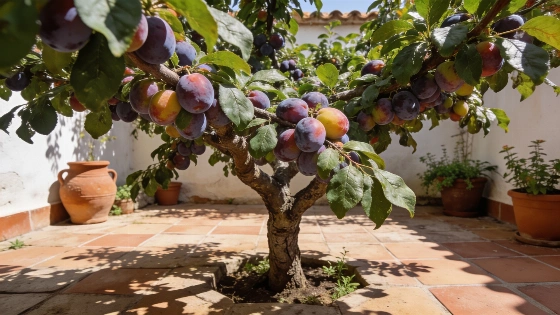
Plum trees can thrive in limited spaces, offering shade and abundant summer fruit. The right rootstock keeps their size manageable, but success depends on sun, drainage and attentive watering. Here’s what to know before planting one in your garden.
Choosing a fruit tree for a small patio often means balancing space, shade and the promise of a good harvest. Recent attention has turned to the plum tree, which—when grafted onto specific rootstocks—can remain compact while still producing generous crops of fruit each summer.
Rootstock selection is crucial. According to the Royal Horticultural Society, the final size of a plum tree depends less on the variety and more on the rootstock beneath it. Options like VVA-1 and Torinel can keep trees as small as 2.4 to 3 meters, making them suitable for tight spaces. Pixy and St Julien A rootstocks allow for slightly larger trees, up to five meters, but still manageable for most gardens. Nurseries should always label both the variety and the rootstock, as well as note whether a pollinator is needed—many plums are self-fertile, but some yield better with a companion tree nearby.
Managing Growth and Roots
Plum trees grafted onto less vigorous rootstocks are easier to prune and harvest, and they adapt well to limited areas. However, no tree offers a guarantee against root spread. Even compact plums can send roots beyond their canopy, especially if soil is loose or moisture is uneven. The Royal Horticultural Society warns that roots may exploit cracks in paving or poorly compacted ground, so it’s wise to plant with some distance from walls and paved areas. Local regulations and planting distances should be checked, especially near property boundaries.
Water and Soil Requirements
While mature plum trees tolerate dry spells, consistent watering is key during fruit development. The Utah State University Extension recommends keeping soil moist but not waterlogged in the first year, then switching to deep, spaced-out watering as the tree matures. Drought during fruit formation can shrink the harvest. Mulching helps retain moisture and suppress weeds, but in containers, soil dries out much faster—large pots of at least 50 centimeters in width and depth are advised for healthy growth.
Sunlight, Pruning and Harvest
Plums perform best in sunny, sheltered spots with fertile, well-drained soil. Early spring blossoms can be vulnerable to late frosts, but attract pollinators like bees. Fruit ripens from summer into early autumn. Bare-root trees are best planted during dormancy, while container-grown specimens can be set out from late autumn to early spring. Annual pruning removes damaged wood and opens the canopy for light, ideally in summer to reduce disease risk. Thinning fruit may be necessary if branches are overloaded. In small patios, training the tree in a fan shape against a wall maximizes space and sunlight. The chosen variety will determine fruit color, flavor, harvest time and pollination needs.
For those considering alternatives, factors like mature size, orientation and water availability should be weighed carefully. As with any tree, thoughtful planning and ongoing care are essential for a healthy, productive plum that fits harmoniously into a small Spanish garden.