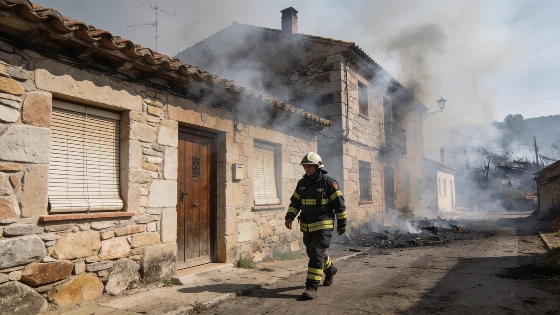
Authorities in Extremadura have ordered the immediate confinement of Nuñomoral’s 1,200 residents after a fast-moving wildfire in Las Hurdes (Cáceres) spread into Salamanca province. The fire began midday Tuesday and is believed to have been deliberately set. It has forced evacuations in multiple villages and now threatens new areas as it advances through Vegas de Domingo Rey in Agallas.
Residents of Nuñomoral received an ES Alert notification at 20:30, instructing them to stay indoors and seal windows and doors. Heavy smoke made going outside unsafe. Those living outside the basic urban area were told to relocate to the Casa de Cultura, where emergency teams are coordinating collective shelter and medical support. The evacuation of Asegur adds to the ten villages already cleared the previous day, affecting around 700 people. The Cottolengo del Padre Alegre care center also relocated its 34 residents and 11 staff to Plasencia, while several vulnerable individuals spent the night in a local care home.
Firefighting efforts remain intense. Crews have deployed 27 forest units and 24 aircraft, along with heavy machinery and specialized teams from the Ministry for Ecological Transition. The situation remains critical, with the Infocaex plan at its highest operational alert. Regional president María Guardiola said shifting winds and forming pyrocumulus clouds have complicated containment, especially on the western front. Progress in the north near El Gasco offers some optimism. Teams are directing resources to the most active zones, where re-ignitions have been reported.
As the basic advance was checked, crews continued extinguishing the fire and carrying out mop-up operations. Reporting by Miguel Ángel Muñoz Rubio in eldia.es described firefighters on Sunday, 23 August, as carrying out final control work. A further citizen protest reflected continuing public concern over the fire and its consequences.
Local authorities have faced resistance from some residents unwilling to evacuate, particularly in Cerezal, requiring intervention by the Guardia Civil. Psychologists and social workers also assisted. Officials continue to urge residents to follow safety instructions to protect lives and property as the fire perimeter remains unstable. The president reiterated that all evidence points to arson, but called for caution as investigations proceed.
With the fire now crossing into Salamanca, the provincial government has mobilized additional firefighting vehicles from Ciudad Rodrigo and Fuenteguinaldo to defend the threatened area of Vegas de Domingo Rey. The priority is to shield populated zones from the advancing flames, as requested by the INFOCAL emergency director. The deployment includes water tankers and rural fire engines, reinforcing the regional response.
The effects extended beyond the immediate firefighting emergency. On 24 August, at Nuñomoral’s request, the Consorcio MásMedio of the Provincial Council of Cáceres deployed two certified water tankers, each with a capacity of 10,000 litres, for a combined 20,000 litres. Rainfall had carried ash into water systems. One tanker was placed in the park opposite the town hall, while the other stood near the Cottolengo facility to serve residents in different population centres. The tanks were to remain available until the water supply was confirmed safe, information from the Consorcio MásMedio.
In early September, Nuñomoral introduced extraordinary restrictions on public-water use. The rules prohibited irrigation of gardens and vegetable plots, as well as vehicle washing. They also banned outdoor cleaning and filling swimming pools. The mayor’s office attributed the measures to exceptional water scarcity and circumstances arising from the fires that had affected the municipality. The restrictions showed how the emergency’s consequences continued to shape local water management after the immediate smoke and evacuation threat had passed.
Spain has faced a series of severe natural disasters in recent years, making emergency protocols and inter-regional cooperation increasingly critical. The current situation in Las Hurdes echoes challenges seen elsewhere in the country, including the mass evacuations following the Granada earthquake, when hundreds spent nights outdoors, as reported in a previous incident covered by russpain.com.
Wildfires in Spain are most common during the summer months and are often worsened by high temperatures and drought, with human activity also a factor. Advanced alert systems and coordinated evacuation plans have become standard practice, aiming to minimize casualties and property loss. As the situation in Las Hurdes and Salamanca develops, authorities continue to monitor conditions and adjust their strategy to protect affected communities.