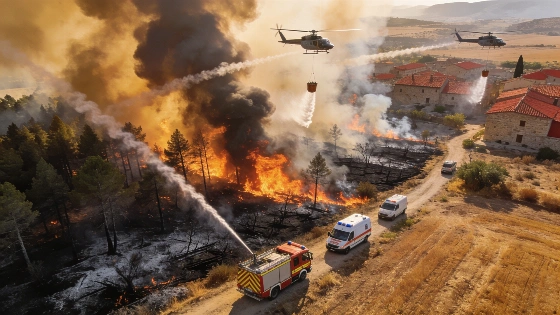
Nearly 12,000 hectares have been scorched in the wildfire that erupted Wednesday in Zaragoza's Cinco Villas area, making it the largest forest fire in Spain this year. The blaze remains active and out of control, and authorities warn that the risk of further spread is very high. Its perimeter has reached 60 kilometers, while emergency services continue to operate under the region's highest forest-fire alert level.
Six towns have been evacuated as a precaution: Orés, Asín, Luesia, Malpica de Arba and Uncastillo in Cinco Villas, along with Petilla de Aragón in Navarra. More than 1,100 residents have been affected by the evacuations, though officials do not currently anticipate further displacements. The A-1204, CV-813 and A-1202 roads remain closed because of the fire, and the power line between Asín and Orés is still down.
More than 400 personnel, supported by dozens of helicopters and water bombers from regional and central governments, are engaged in firefighting efforts. The Unidad Militar de Emergencias (UME) has deployed three sections, with reinforcements arriving from Navarra, Castilla y León, La Rioja and Comunidad Valenciana. Overnight, teams focused on protecting homes in Malpica de Arba and Uncastillo. In Asín, flames have damaged ten houses and a goat farm.
Regional president Jorge Azcón said he hoped a shift in wind direction could help bring the situation under control, but stressed that the fire remains uncontained. Interior Minister Roberto Bermúdez de Castro cautioned that the perimeter cannot yet be considered secure and the risk of further expansion persists. The Special Civil Protection Plan for Forest Fires (PROCINFO) remains at Operational Situation 2, Level 2.
On Friday, Sara Aagesen, Spain's third vice president and Minister for Ecological Transition and Demographic Challenge, visited the command post in Farasdués. She said 50,000 hectares had burned across Spain since the start of the year, with 18 major wildfires recorded, three times the number at the same point last year. During her visit, the minister stressed the urgent need for prevention and caution.
National totals rose sharply as the 2026 fire season continued. Ministry data through October 4 recorded 280,079 hectares burned in 8,635 fires, 140% above the decade average. Separately, the European Forest Fire Information System (EFFIS) estimated that 301,299 hectares had burned by October 19, with 49 large fires accounting for roughly 241,000 hectares. The system's historical average for large fires is 23. These later figures place the Cinco Villas blaze within an exceptionally severe national season.
Spain has faced a series of severe wildfires in recent years, with climate conditions and land management practices contributing to increased risk. The current situation in Zaragoza follows other impressive incidents, including the deadly blaze in Almería, where authorities recently contained the fire and identified victims, as reported in coverage of the Los Gallardos fire response. The emergency in Cinco Villas highlights the persistent threat wildfires pose to rural communities and infrastructure, as well as to Spain's environment.
Aragón's subsequent recovery planning identified the blaze as the Orés fire, affecting Orés, Asín, Ejea de los Caballeros, Luesia, Biota and Uncastillo. The regional Department of Environment and Tourism coordinated with municipal representatives on restoration measures, including small barriers in ravines and gullies, fascines on slopes, straw to protect exposed soil and on-site wood chipping. The work is being prioritized information from erosion risk, slope, soil conditions, the capacity for vegetation to regenerate and access to damaged land. These measures are intended to limit runoff and further soil loss after the flames.
The recovery effort also included economic assistance. In a later update, the Aragón government reported 18 additional aid applications from the Orés and Cinco Villas area, with €80,397.90 requested and €74,670.78 initially deemed eligible for subsidy. The applications show that the fire's effects extended beyond the emergency response to local businesses and livelihoods.
Forest fires in Spain are most common during the dry summer months, but in recent years the fire season has lengthened with changing weather patterns. High temperatures and prolonged drought can leave areas vulnerable, while strong winds can quickly turn small outbreaks into large-scale emergencies. Authorities continue to urge residents in affected areas to follow official instructions and remain vigilant as firefighting operations continue.