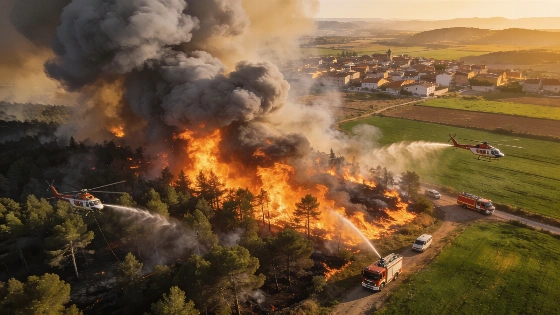
Emergency teams in Aragón are battling a wildfire in Orés (Zaragoza) that has burned more than 15,400 hectares, making it one of the region’s most severe incidents in recent memory. The fire broke out on Wednesday and has forced the evacuation of seven villages, six in Zaragoza province and one in Navarra. Three additional municipalities remain on standby for possible evacuation. Its perimeter now stretches for around 60 kilometers, complicating containment efforts.
Erratic winds and difficult terrain, with forests and farmland alongside scrub and deep ravines, have made firefighting particularly difficult, regional authorities say. The affected area includes inhabited towns, adding urgency to the response. On Friday, approximately 450 personnel and 22 aircraft were deployed, with support from the Unidad Militar de Emergencias (UME). Crews are expected to maintain the same scale of operation through Saturday as they work to stop the fire spreading further.
The evacuated locations are Orés, Asín, Luesia, Malpica de Arba, Peraltilla, Uncastillo and Petilla de Aragón. Longás, Isuerre and Lobera de Onsella are on alert, and residents have been advised to prepare for a possible evacuation if conditions worsen. Authorities are closely monitoring wind patterns and fire behavior as the situation remains fluid.
Spain is experiencing an exceptionally challenging wildfire season. Minister for the Ecological Transition and Demographic Challenge Sara Aagesen said nearly 50,000 hectares had burned nationwide in the first seven months of the year across 18 major fires, three times the area affected during the same period in 2025, information from ministry data. Aagesen visited the Advanced Command Post in Farasdués (Zaragoza), where the response to the Orés fire is being coordinated. The later national balance underscored the scale of the season: by October 4, 280,079 hectares had burned in 8,635 fires, including 47 large fires. Through September 21, the Ministry for the Ecological Transition and the Demographic Challenge also reported 10,067.19 flight hours, 2,659 firefighting sorties and 50,259 water drops.
Large fires accounted for a disproportionate share of the damage nationally. Fires exceeding 500 hectares made up less than 1% of incidents but represented 80.5% of the burned area. Their average size was 4,925 hectares, 59% above the 10-year average. The Orés fire’s reported perimeter of about 60 kilometers and burned area of more than 15,400 hectares show the scale of the containment challenge.
The fire’s effects extended beyond the immediate emergency. Restoration planning covered damaged land in Orés, Asín, Ejea de los Caballeros, Luesia, Biota and Uncastillo. Proposed work includes erosion control in ravines and gullies, fascines on slopes, straw to protect exposed soil and on-site wood chipping. Aragón environmental authorities discussed the recovery work with mayors and councillors from affected municipalities.
On October 20, Spain’s Council of Ministers approved up to €9 million in support for insured agricultural and livestock operations affected by fires declared between January 1 and September 7, 2026. The measures supplement insurance compensation and apply to eligible losses. The government said more than 270,000 hectares had been affected nationally, including about 60,000 hectares of agricultural land. Rates include €3,500 per hectare for fruit trees, €1,900 per hectare for citrus, €450 per affected bovine animal and €120 per beehive. Agriculture Minister Luis Planas described agricultural insurance as “the best tool for emergency management.”
The latest blaze follows a series of large-scale wildfires in Spain in recent years. A previous major fire in the same region led to the evacuation of five towns and burned more than 12,000 hectares, as detailed in this earlier report on the Orés wildfire crisis. The current fire adds to the demands on emergency services during peak fire season and the risks facing rural communities during extreme weather.
Wildfires are a recurring threat in Spain, particularly in regions such as Aragón, Castilla y León and Andalucía, where dry summers and strong winds can quickly turn small fires into major emergencies. Residents in affected areas are urged to follow official instructions and stay prepared for sudden changes in the situation.