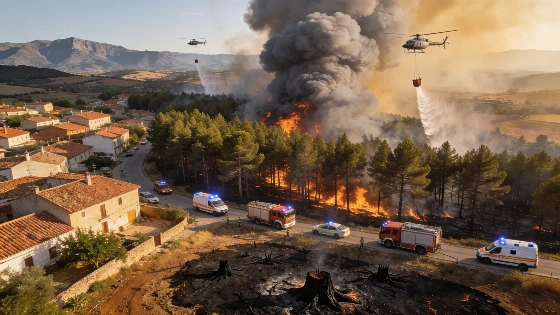
More than 12,000 hectares burned in the wildfire in Orés, Zaragoza, prompting Aragón authorities to order evacuations in five towns and affecting around 1,000 people. The blaze was one of several that made the 2026 season an exceptional emergency across Spain. By October, the response had shifted from suppression to recovery planning in the affected municipalities of Orés, Asín, Ejea de los Caballeros, Luesia, Biota and Uncastillo.
At the height of the emergency, approximately 450 personnel and more than 30 aerial units were deployed to secure the perimeter, alongside over 300 members of Spain’s Military Emergency Unit (UME). High temperatures, low humidity and sudden changes in wind direction complicated efforts to establish and hold fire lines. Nearly 700 people were evacuated from several municipalities as a precaution.
By October 2026, Aragón’s environmental authorities were coordinating restoration priorities with local officials. Meetings in Jaca and Ejea de los Caballeros brought together regional and provincial officials, along with forestry engineers and nature-protection officers, to assess municipal requests. The regional government’s work included erosion-control measures: small barriers in ravines, fascines on slopes, straw applications and on-site wood chipping. Luis Biendicho, Aragón’s regional minister for the environment and tourism, and Ana Oliván, director-general for forest management, were among the officials involved. Forest engineer Carlos Cacho had helped direct suppression operations.
The La Mierla fire in Guadalajara, declared on 16 July, ultimately burned 34,447 hectares, most of them within Sierra Norte Natural Park. It remained active for 51 days before being officially extinguished on 4 September. The final impact far exceeded the roughly 2,000 hectares cited during the initial emergency. Later figures put the number evacuated at approximately 1,200 to 1,500 people from 34 localities, while residents of another 14 municipalities were confined. EFE Verde reported that nearly two months after the fire was extinguished, firefighters and residents undertook a 75-kilometre route across the burned area to document damage and press for rehabilitation.
The destruction in Sierra Norte extended beyond the loss of forest cover. Wildlife movements were affected, and animals were displaced toward the park’s margins. Cadena SER Guadalajara also reported ozone pollution in parts of the area, associated with lost vegetation and high temperatures, as well as pollutants carried by wind from the A-2 motorway and Madrid. The fire’s aftermath has become a longer-term challenge for habitat recovery and rural communities, as well as an emergency-response issue.
Investigations into the causes of several fires were also under way. In La Mierla, early reporting linked the suspected origin to work involving a combine harvester; the case later entered judicial proceedings. The cause remained unresolved, and no criminal responsibility had been established. The investigation does not establish that any particular agricultural worker or named mayor caused the fire. The Guardia Civil was also examining suspected negligence in connection with an incident in Adamuz, Córdoba.
Spain has experienced increasingly severe heatwaves in recent years, with temperatures often exceeding 40°C. These conditions have increased wildfire risks. In 2025 alone, more than 393,000 hectares were lost to fire, a record high for the country, as reported by the European Forest Fire Information System. The Ministry of Agriculture, Fisheries and Food later said the 2026 fires had affected more than 270,000 hectares nationally, including approximately 60,000 hectares of agricultural land, as the government prepared aid for damaged agricultural holdings. During the summer emergency, Spain’s ES-Alert system also saw exceptional use: it issued an average of 2.5 alerts per day between June and August, with 28 alerts on 25 July, the highest daily total reported.
The current crisis echoes previous wildfire emergencies in Spain, including the Los Gallardos fire in Almería, which was recently brought under control after impressive losses and official intervention. For more on how authorities managed that incident and the identification of victims, see this detailed report: Almería wildfire response and aftermath.
Wildfires remain a persistent threat across Spain, particularly during summer, when heat, low humidity and shifting winds can create dangerous conditions. Residents in affected areas are urged to follow official instructions and remain alert to further developments as firefighting and recovery work continue.