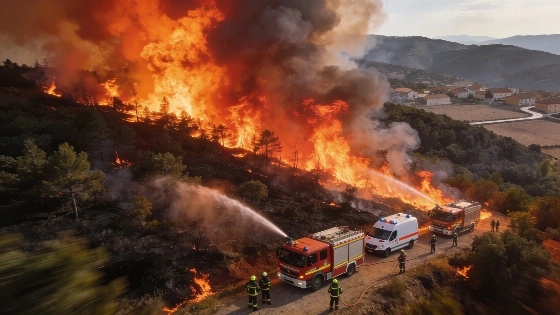
More than 12,000 hectares have burned in a fast-moving wildfire that erupted in Orés, Zaragoza province, forcing urgent evacuations across six villages in the Cinco Villas region and neighboring Navarra. The fire began on Wednesday and intensified overnight despite shifting winds, moving dangerously close to Uncastillo’s historic center. Emergency teams worked through the night to protect the town, saving its urban basic as surrounding areas suffered extensive damage.
By early Friday, more than a thousand evacuees remained in shelters in Ejea de los Caballeros. Many reported sleepless nights amid anxiety and uncertainty. Zaragoza’s crisis center convened at 9 a.m. to assess the situation and determine next steps. Sara Aagesen, Spain’s third vice president and Minister for the Ecological Transition and Demographic Challenge, was scheduled to arrive at the advanced command post in Farasdués with Aragón’s regional president, Jorge Azcón (PP).
In its latest statement, the regional government said the fire remained highly active after expanding significantly overnight. Ground crews have been reinforced, but the fire perimeter has reached 60 kilometers. Authorities have prioritized protecting evacuated urban centers, including Malpica de Arba and Uncastillo, as flames reached the outskirts of both towns. Three regional roads remain closed. Emergency resources from Navarra, Castilla y León, La Rioja and the Valencian Community are fully deployed. The incident remains at level 2, with the Military Emergency Unit (UME) activated and all available forces engaged.
Uncastillo’s mayor, among the evacuees in Ejea, described the fire as relentless as it advanced from one village to the next. Friday’s outlook is grim: forecasts predict high temperatures and low humidity, conditions that could further complicate containment efforts. The response echoes recent emergencies elsewhere in Spain, including the Los Gallardos fire in Almería, where authorities faced similar challenges controlling the blaze and managing evacuations, as detailed in this report on the Los Gallardos wildfire response.
The fire’s consequences extend beyond the immediate emergency. Subsequent restoration planning has covered the municipal territories of Orés, Asín, Ejea de los Caballeros, Luesia, Biota and Uncastillo. Aragón’s environmental authorities consulted the affected municipalities on local needs and priorities, tailoring restoration measures to erosion risk and slope, along with soil conditions, natural vegetation recovery capacity and access to the land. Work has included small barriers in ravines and gullies, fascines on slopes, straw application and on-site wood shredding to limit soil loss and support recovery. Carlos Cacho, a forestry engineer and head of the regional government’s Forest Management Unit, attributed the difficult firefighting conditions to high temperatures, low humidity and frequent, unexpected changes in wind direction.
The economic impact is also evident in Aragón’s aid process for businesses and self-employed workers. The regional government recorded 18 applications linked to the Orés-Cinco Villas fire, seeking €80,397.90 in total, with an initially eligible maximum of €74,670.78. The applications remain subject to checks on eligibility and supporting documents. They formed part of a regional program that received 44 applications overall, representing €433,189.19 requested against a €3 million budget. Another 24 applications came from the Las Peñas de Riglos-Jacetania fire. Together, the two principal fire-affected areas accounted for 42 applications, or 95.5% of the total. The regional Department of Economy, Competitiveness and Employment said Aragón had sufficient resources to meet its aid commitments.
At national level, Spain’s government approved €9 million in direct aid for agricultural and livestock holdings damaged by the 2026 wildfires. Applicants must meet conditions that include holding a qualifying combined agricultural-insurance policy. The measure is part of the wider response to fire-related agricultural losses: the government reported that fires had affected about 270,000 hectares nationwide during the year, including around 60,000 hectares of agricultural land. It establishes a national compensation structure. The Aragón applications described above concern separate regional aid for businesses and self-employed workers.
Wildfires regularly threaten Spain’s rural regions, particularly during periods of extreme heat and drought. The Cinco Villas area, known for its agricultural landscapes and historic villages, is especially vulnerable because of its dry terrain and scattered settlements. In recent years, Spanish authorities have increased investment in fire prevention and rapid response, but incidents like the Orés fire show how difficult they remain to contain. The emergency highlights the need for coordination across local, regional and national agencies, alongside continued vigilance as climate conditions evolve. Residents affected by the fire face uncertainty about when they can return home and what damage awaits them, while emergency teams remain on high alert for further developments.