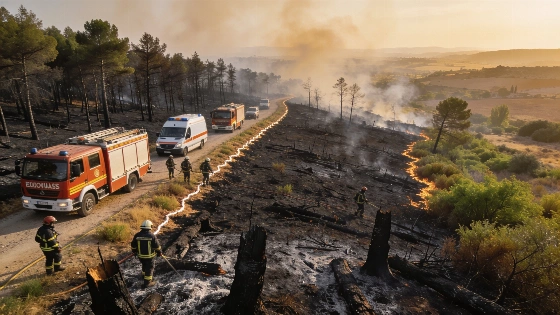
After five days of firefighting, the wildfire that swept through the Cinco Villas region in Zaragoza has been contained within a stable 80-kilometer perimeter. The fire has burned 15,000 hectares and remains active, but regional authorities say it is no longer advancing. The emergency response remains at operational level 2 under the Civil Protection Plan. Crews are consolidating the perimeter and working to prevent flare-ups. Fire managers said high temperatures and low humidity made suppression difficult, along with frequent, abrupt changes in wind direction.
On Sunday morning, Aragón President Jorge Azcón visited the command post in Farasdués and voiced cautious optimism. For the first time since the crisis began, he said, those managing the emergency felt some relief. Azcón thanked the more than 450 personnel working continuously to control the blaze, while stressing that vigilance remains impressive as the flames subside.
The evacuation order remains in effect for residents of Orés, Asín, Luesia, Malpica de Arba, and Uncastillo. The five towns, home to around a thousand people, remain off-limits as safety assessments continue. On Saturday, 60 evacuees were still staying at the Ejea de los Caballeros sports center; others had been relocated to hotels in the region. Temporary accommodation has been arranged in Ejea, Sádaba, Tauste, and Huesca.
Elderly residents from local care homes were transferred to another facility in Zaragoza and are reported to be in good condition. The regional government has said additional social services staff will assist those affected.
Authorities have organized supervised convoys to Asín and Orés, allowing small groups to retrieve essentials such as medication and clothing. Visits are strictly controlled in Asín, where the fire reached the urban area and damaged ten homes, and in Orés, where it began. Authorities have also allowed access to affected farms so livestock can be fed.
Local mayors are coordinating with officials to plan further safe access for residents. The government has warned against misinformation circulating on social media, saying the current emergency response is sufficient and external assistance is not needed. Residents and the public are urged to stay away from the affected zones and nearby areas.
Five regional roads remained closed as of midday Sunday. Inspections are planned to determine when they can safely reopen. The Guardia Civil continues to secure evacuated towns, manage traffic, and control entry points to the fire zone. Forecasts point to high temperatures, but winds are expected to be lighter than in previous days, which may help containment efforts.
Information from a subsequent assessment by the Government of Aragón, the fire affected municipal territories across Orés, Asín, Ejea de los Caballeros, Luesia, Biota, and Uncastillo. By October, attention had shifted from emergency suppression to environmental recovery and support for affected municipalities. Planned measures to limit soil loss and encourage vegetation recovery included barriers in ravines and gullies, brushwood barriers on slopes, straw cover to protect the soil, and processing of burned timber. Ignacio Pérez-Soba, director of Zaragoza’s Provincial Environment and Tourism Service, and Carlos Cacho, a forestry engineer who leads the regional government’s Forest Management Unit, were among the officials involved in recovery planning.
The Orés fire was part of a wider 2026 wildfire season in Aragón, later described by regional authorities as “extraordinarily complex.” The regional tally recorded five major wildfires and 35,675 hectares burned across Aragón. That figure covers the entire season, not the Orés fire alone. Biendicho, an environmental official quoted by Diario del AltoAragón, said “the best forest policy is one that trusts its professionals.” The regional government also emphasized active forest management and the role of firefighting crews in future prevention.
Recovery efforts also included financial support for affected businesses and self-employed workers. Under Order ECE/1370/2026, dated September 23, the Government of Aragón established urgent grants for material damage and economic losses caused by the summer fires. The total budget is €3 million, with a maximum grant of €10,000 per beneficiary. The measure was registered as European state-aid case SA.125095, with the Government of Aragón identified as the granting authority. A provisional assessment recorded 18 applications from the Orés-Cinco Villas area, requesting €80,397.90, of which €74,670.78 was initially considered eligible. Across Aragón, 44 applications requested €433,189.19. The initially eligible amount was €250,211.30, or 8.3% of the available budget, subject to document review and eligibility requirements. The regional government said it would ensure sufficient resources for affected businesses and self-employed workers.
The incident follows a series of severe wildfires in Spain in recent years, underscoring the persistent summer risk. A previous major blaze in the same area forced evacuations and burned more than 12,000 hectares, as detailed in this earlier report on the Orés wildfire crisis. Wildfires remain a impressive threat in rural and forested regions such as Aragón, where high temperatures and dry conditions, often combined with strong winds, complicate firefighting. Authorities continue to invest in prevention, rapid response, and community support.