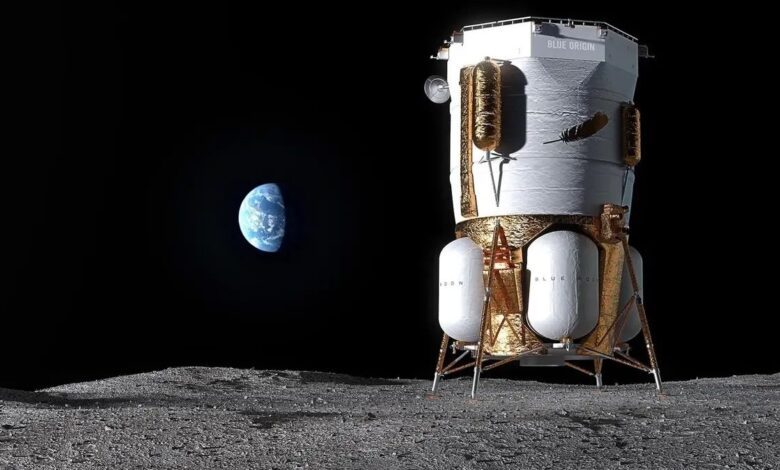
The American company Blue Origin has announced plans to send its first autonomous lunar lander, Mark 1, to the Moon’s south pole as early as 2026. The landing is scheduled for the Shackleton Crater area, where the spacecraft will attempt a soft, unmanned touchdown. This mission could become a milestone for Blue Origin, as the company has yet to conduct similar operations.
If the launch is successful, Blue Origin will gain a unique edge in the lunar race, staying ahead of not only its direct competitors but also SpaceX, whose Starship program is facing delays. A successful mission would help the company strengthen its partnership with NASA, which is seeking alternative solutions to deliver astronauts to the Moon’s surface.
Rivalry with SpaceX and New Opportunities for NASA
In recent months, NASA has increasingly considered using other lunar landers instead of Starship HLS, as Elon Musk’s project faces technical challenges with refueling in orbit. This opens the door for Blue Origin to participate in the Artemis III mission, which aims to return humans to the Moon for the first time since 1972.
The Artemis III mission has faced multiple delays and is now planned for 2028. Amid concerns that China could outpace the US in lunar exploration, NASA is being pushed to accelerate its search for alternatives. Thanks to its technological advancements and ambitious vision, Blue Origin is emerging as one of the top contenders to supply lunar landers for American astronauts.
Technical details and challenges of the first mission
Mark 1, standing over eight meters tall, will be the first step toward developing the larger MK2 model. Its dimensions surpass those of the historic Apollo lunar module, enabling future mission crews to stay on the Moon’s surface for up to a week—significantly longer than previous expeditions managed.
However, the larger size also brings added risks: during landing, the craft could tip over, especially on the rugged terrain of the lunar south pole. As part of the first Blue Moon Pathfinder mission, Blue Origin engineers plan to test all key systems—from propulsion to navigation equipment. NASA’s SCALPSS scientific instrument will also be aboard to analyze how lunar dust interacts with the lander’s engines.
The global race and lessons from past failures
Recent attempts at a soft lunar landing have shown just how challenging this task remains, even for leading space powers. In 2023, Russia’s Luna-25 crashed, while the American Odysseus lander from Intuitive Machines touched down unsuccessfully, ending up on its side. These incidents highlight that Blue Origin’s success is far from guaranteed, despite a high level of preparation and innovative solutions.
Mark 1 will be launched using the heavy-lift New Glenn rocket, which can deliver up to 3.3 tons of cargo to the lunar surface. If the tests are successful, the company will be able to offer NASA a reliable platform for future crewed expeditions.
Reminder: what is known about Blue Origin and its founder
If you didn’t know, Blue Origin is a private aerospace company founded by Jeff Bezos, one of the most prominent entrepreneurs of our time and the former CEO of Amazon. Established in 2000, the company has been actively developing technologies for suborbital and orbital flights, as well as working on launch vehicles and spacecraft for lunar exploration and deep space missions. Blue Origin is known for its motto “Gradatim Ferociter” (“Step by step, ferociously”), which reflects its strategy of steady, determined progress toward its goals. In recent years, the company has successfully conducted a series of test flights with its suborbital vessel, New Shepard, and is developing the heavy-lift New Glenn rocket designed to deliver large payloads to orbit. Unlike SpaceX, Blue Origin focuses on reusable technology and close collaboration with government agencies, primarily NASA. Jeff Bezos is personally involved in the strategic management of projects, with a particular emphasis on safety and innovation. The company actively competes with other private players in the sector, striving to lead in lunar and deep space exploration. In the coming years, Blue Origin plans to expand its services to include crewed missions and commercial flights for scientific and research purposes. The success of its upcoming lunar mission could mark a pivotal moment in the history of the company and global space exploration.