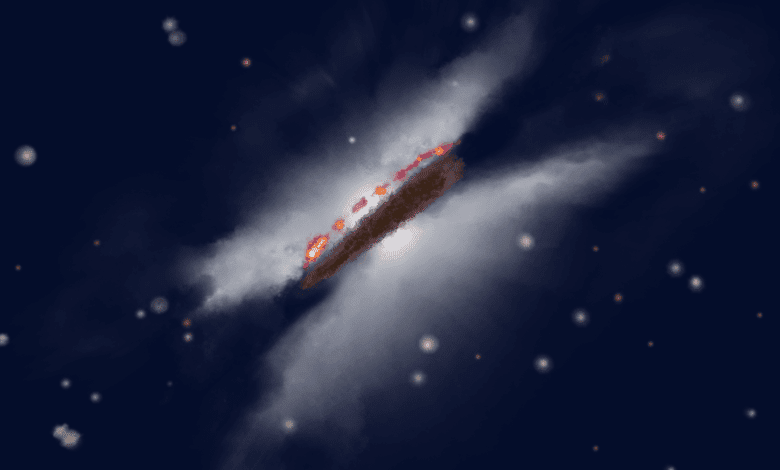
In the world of astronomy, true discoveries that upend our understanding of planet formation are rare. Yet that’s precisely what happened when an international team of researchers, equipped with the powerful ALMA radio telescope, turned their gaze to a mysterious object known as Gomez’s Hamburger. This isn’t just another protoplanetary disk—its sheer size and structure astonish even the most seasoned experts. From Earth, the object appears as a massive sandwich of gas and dust, with its layers resembling buns and a young star as the juicy filling. But behind this culinary image lies something far more thrilling: the very first signs of new planets forming—possibly giants—that could transform our view of cosmic processes.
Unlike most such disks, Gomez’s Hamburger lies almost perfectly edge-on to our line of sight. This offers a unique chance to peer inside its structure, as if slicing a pie in half. For the first time, astronomers have been able to trace in detail how gases and dust are distributed within the disk, discovering that the material is arranged in a strict sequence: light molecules float near the top, while heavier ones settle closer to the center. This kind of stratification is a rare scientific stroke of luck, as such details are usually hidden from view at other angles.
Structure and Scale
Gomez’s Burger is a true giant among its kind. Its gas envelope stretches a distance 2,000 times greater than the gap between Earth and the Sun, with layers reaching heights of several hundred astronomical units. Inside this colossal structure lies a vast amount of dust—several times more than in any other known protoplanetary disk. This abundance of building material gives the system the potential to become home to several massive planets, possibly an entire planetary family.
But things aren’t as symmetrical and perfect as they may seem at first glance. One side of the disk is noticeably brighter and broader than the other, indicating the presence of powerful vortices or even local disturbances. According to scientists, it’s in these regions that planet embryos—dense clumps of matter destined to become new worlds—are likely to take shape. Such asymmetries are rare in objects of this size, making Gomez’s Burger particularly valuable for observation.
Dynamics and processes
ALMA not only revealed the structure of the disk but also allowed scientists to track the movement of its components. It turns out that the gas flows inside Gomez’s Burger behave in extremely unusual ways. On one side, astronomers detected a kind of ‘wind’—a stream of ionized gas carried away under the influence of the young star’s radiation. This phenomenon, known as photoevaporation, can significantly affect the disk’s evolution and may even determine where new planets will form.
Special attention has been drawn to an arc of sulfur dioxide located beyond the main dust mass. This arc coincides with a dense clump, provisionally named GoHam b. According to researchers, this is where gravitational collapse is currently taking place—the material is compressing under its own gravity, laying the foundation for a future giant planet. If this hypothesis is confirmed, the Gomez Hamburger would become the first object where such an early stage of planet formation has been recorded at a considerable distance from its star.
The significance of the discovery
Why is this important? Until now, it was believed that giant planets formed mainly closer to their stars, where the density of matter is higher. The Gomez Hamburger disproves this stereotype: here, the conditions for planet formation exist even on the periphery, in cold and sparse regions. This discovery challenges many existing theories and may explain why, in some exoplanetary systems, giants orbit at vast distances from their stars.
In addition, the unique orientation of the disk allows scientists to test computer models of protoplanetary system evolution with unprecedented accuracy. The Gomez Hamburger serves as a kind of open-air laboratory, allowing observation of processes that are usually hidden from view. And perhaps, in the coming years, this is where the first direct evidence of how new worlds are born will emerge.
Looking to the future
While astronomers continue to analyze data and develop new hypotheses, Gomez’s Hamburger has already become a true sensation. Studying this phenomenon not only expands scientific horizons but also inspires the search for other similar objects in the depths of the Universe. Who knows how many more cosmic “hamburgers” are hiding among the stars and what surprises they may hold for humanity?
RUSSPAIN reminds readers that the Atacama Large Millimeter/submillimeter Array (ALMA) is the world’s largest radio interferometer, located over 5,000 meters above sea level in Chile’s Atacama Desert. The complex consists of 66 antennas operating in millimeter and submillimeter wavelengths, providing record-breaking image resolution. ALMA is used to study star and planet formation processes and to search for organic molecules in space. Thanks to this project, scientists regularly make discoveries that reshape our understanding of the Universe’s structure and evolution.