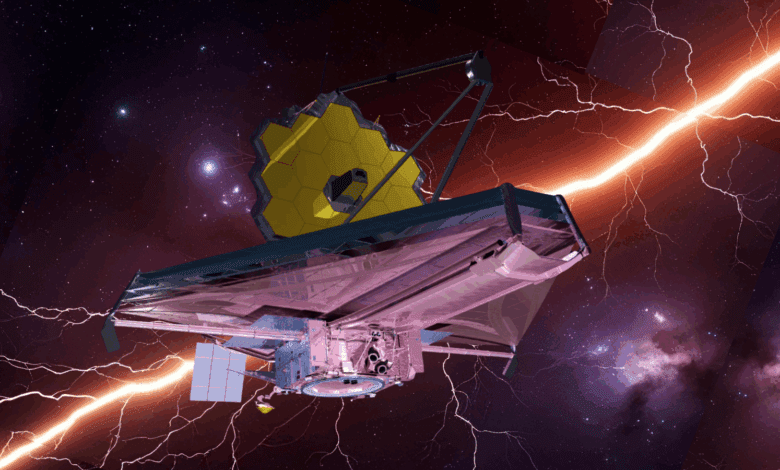
Since its launch in 2022, the James Webb Space Telescope (JWST) has become a breakthrough for astronomy. Thanks to its highly sensitive instruments, scientists have been able to observe the earliest stages of the Universe’s formation. However, one of cosmology’s greatest mysteries—the nature of dark matter—has remained out of reach even for this unique observatory. New studies published in 2025 suggest that this may soon change.
Dark matter, according to astrophysicists, makes up about 85% of all matter in the Universe. It does not interact with electromagnetic radiation, meaning it neither emits nor absorbs light. This makes it invisible to most telescopes. The particles that comprise dark matter are unlike the familiar protons, neutrons, and electrons that make up all visible matter—from stars to the smallest organisms. Despite decades of searching, none of the proposed candidates for dark matter particles have been detected directly.
The only way to “see” dark matter is by observing its gravitational effects on surrounding space, ordinary matter, and light. This approach is at the heart of a new study, in which scientists focused on the unusual elongated shapes of young galaxies discovered by JWST. They believe the gravity of dark matter may explain this strange morphology.
Unusual galaxies
Astronomers note that JWST has allowed them to peer into the era when the first galaxies were just beginning to form. Unlike the familiar spherical or spiral shapes, many of these early galaxies appear elongated, like threads. This contradicts the results of computer simulations based on the standard cosmological model—the so-called Lambda-CDM (Lambda-Cold Dark Matter), which predicts galaxies should be more rounded.
A research team led by Rogier Windhorst from Arizona State University has suggested that this elongated shape may be related to the properties of dark matter. Specifically, if dark matter consists of ultralight axions with quantum properties, their wave-like behavior could smooth out small-scale structures and form extended filaments connecting regions of star formation.
Waves and particles
To test this hypothesis, scientists conducted a series of computer simulations using various scenarios: from classical cold dark matter to alternative forms—’warm’ and ‘wave’ dark matter. They found that ultralight axions, with their wave-like nature, can explain the elongated morphology of early galaxies observed by JWST.
According to Álvaro Pozo from the Donostia International Physics Center, if dark matter does indeed consist of such particles, their quantum properties prevent structures smaller than a certain size from forming. This leads to the emergence of smooth filaments along which gas and stars gradually flow, forming elongated galaxies.
An alternative hypothesis is the existence of ‘warm’ dark matter, such as sterile neutrinos, which move faster than their cold counterparts. In this case, extended structures also form, but the mechanism behind their formation is different. In both scenarios, the observed shapes of galaxies could be key to uncovering the nature of dark matter.
The future of research
JWST continues to detect more and more unusual objects at the edge of the observable universe. At the same time, scientists are refining computer models to more accurately reproduce the processes that took place billions of years ago. Comparing real observations with theoretical calculations could bring humanity closer to unraveling one of the universe’s greatest mysteries in the coming years.
The study, published in December 2024 in the journal Nature Astronomy, has already sparked lively debate within the scientific community. Many experts believe that JWST may not only confirm or refute existing theories, but also open entirely new horizons in our understanding of the universe.
If you didn’t know, the James Webb Space Telescope (JWST) is the largest and most advanced astronomical instrument ever launched into space. Its main mission is to study the early stages of the Universe’s evolution, as well as the formation of galaxies, stars, and planetary systems. The project is a collaboration between NASA, the European Space Agency, and the Canadian Space Agency. Thanks to JWST’s unique capabilities, scientists have already made many discoveries that are reshaping our understanding of the cosmos.