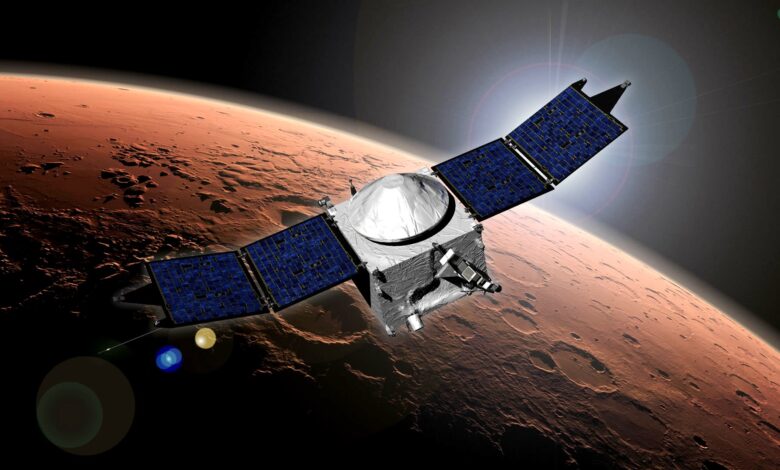
Nearly a month and a half ago, the MAVEN Mars orbiter suddenly stopped responding to signals from Earth. After a forced pause caused by a solar eclipse, NASA is once again trying to pick up any hint of a response from the spacecraft, which for many years served as an essential link between the Red Planet and scientists back on Earth. The situation is even more complicated because MAVEN is not just a scientific instrument—it is a critical data relay for the Curiosity and Perseverance rovers.
In December of last year, MAVEN, as usual, slipped behind Mars, temporarily disrupting communications. But after emerging from behind the planet, the probe showed no signs of life. The last telemetry received before the blackout showed no indications of malfunction. However, analysis of fragmentary data suggests MAVEN began spinning in an unusual way and may have left its planned orbit.
Ominous Silence
Since then, despite numerous attempts to reestablish contact, the probe remains silent. Even the Curiosity rover tried twice to spot MAVEN in the Martian sky, but without success. At the end of December, NASA had to halt all communication attempts completely because of a solar eclipse, when radio signals between Earth and Mars become unstable and risky for spacecraft control.
Now that the solar eclipse is over, engineers are once again powering up antennas, hoping to catch even a faint signal. Yet the scientific community is already voicing pessimistic outlooks: with each passing day, the chances of bringing MAVEN back to life are dwindling.
The Critical Role of MAVEN
Launched in 2013, MAVEN has become not only a source of unique data on the Martian atmosphere over its ten years of operation, but also a key element of Mars’ communications infrastructure. Its antennas relayed data from rovers back to Earth and ensured command communication for their operations. Without MAVEN, the burden falls to other orbiters—Mars Reconnaissance Orbiter, Mars Odyssey, and the European ExoMars and Mars Express—but their capacity is barely enough to meet all the needs.
The loss of MAVEN is especially painful against the backdrop of technical issues that have plagued the craft in recent years. In 2022, it endured a three-month ‘safe mode’ due to failures in its orientation system. Engineers had to urgently implement an alternative method of stellar navigation to reduce reliance on worn-out gyroscopes. Although this navigation was less accurate, it allowed the mission to continue.
Implications for science
MAVEN’s prolonged silence threatens not only the loss of a unique scientific tool, but also the disruption of critical missions. The spacecraft was intended as a communications link for the ambitious Mars sample return program with Perseverance. These plans are now in jeopardy, and the scientific community is being forced to reconsider its research strategy.
NASA has already revised the work schedules for its Mars rovers to compensate for the loss of MAVEN. The remaining orbiters are operating at full capacity, and scientists are forced to reduce the amount of transmitted data and adjust experiment plans. With every minute of communication at a premium, even minor disruptions can result in the loss of valuable scientific findings.
Technical challenges
The history of MAVEN is not only an example of engineering excellence, but also a reminder of the fragility of space missions. Designed for just one year of operation, the spacecraft lasted more than ten years despite equipment wear and the constant threats of deep space. Even now, with enough fuel onboard to stay in orbit until 2030, the fate of the mission hinges on one thing—whether the team can bring the spacecraft back to life.
As engineers continue efforts to restore contact, the scientific community is holding its breath. Losing MAVEN would deal a serious blow to Martian research and cast doubt on the future of Mars exploration programs.
RUSSPAIN reminds that MAVEN (Mars Atmosphere and Volatile Evolution) is an American unmanned probe launched in November 2013 to study the upper layers of Mars’ atmosphere and its interaction with the solar wind. Over the years, the spacecraft has collected unique data on atmospheric loss, Martian storms, and auroras. In addition to its scientific objectives, MAVEN has also served as a relay station for data transmission between Earth and Mars rovers. The mission was extended until 2025, with enough fuel reserves expected to keep it operational through the end of the decade.