The situation in Aragón is becoming key to understanding the future of Spain’s political landscape. For more than four decades, no party here has been able to form a government on its own. This creates unique conditions for the emergence of unexpected alliances and instability, directly impacting the lives of local residents and the allocation of resources.
Since 1983, when the first elections to the regional government took place, no political force has secured an absolute majority. Multiparty politics has become a hallmark of the region, while traditional regionalist parties, once influential, are gradually losing ground. This is especially evident in the case of the Partido Aragonés (PAR), which over the years has formed coalitions and even led the government, but now, for the first time, risks failing to enter the regional parliament.
Historical changes
For a long time, the Socialists (PSOE) remained the most influential force in Aragón, holding power for 26 years. Their longest stretch in office is linked to Marcelino Iglesias, who led the region from 1999 to 2011. The Partido Popular (PP) has also had its successes, but has never managed to secure a second consecutive term. The only exception has been the Socialists, who achieved this twice—under Iglesias and Javier Lambán, who passed away in 2025.
The PP’s results have fluctuated: their worst showing was 13 seats in 1987, and their second-worst was 16 in 2019. The party’s best performance came in 2011, when it secured 30 seats. According to recent polls, PP could match this success in 2026, which would send a significant signal to the entire country.
Vote dynamics
In percentage terms, support for PP ranged from 15.7% in 1987 to 39% in 1999. Even then, the party was unable to form a government due to a coalition between PAR and the Socialists. Now, polls predict the Socialists’ worst result ever—23.2% of the vote and fewer seats than before.
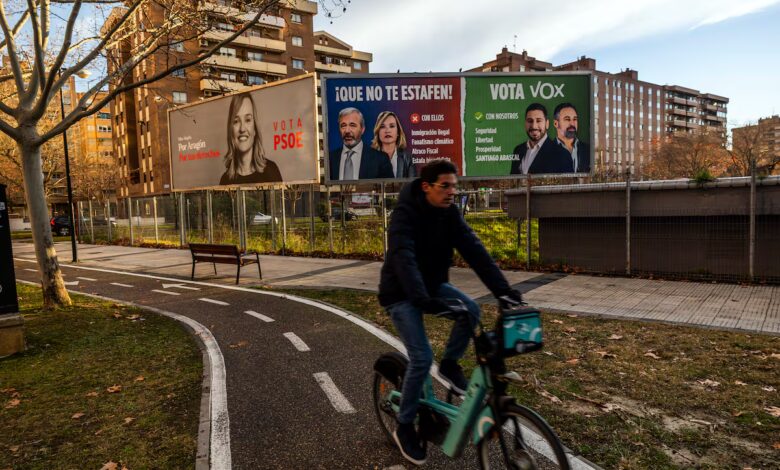
Vox, which first entered the regional parliament in 2019, secured third place by 2023 and is now forecast to double its presence. The average ideological score among Aragon’s residents is 5.2 on a scale from 0 (far left) to 10 (far right), slightly to the right of the national average.
The departure of regionalists
Regionalist parties, which long played the role of political brokers, are losing influence. PAR, once known for forming coalitions both with the left and the right, may now fail to enter parliament for the first time. Other regional forces, such as Chunta Aragonesista and Aragón Existe, still maintain representation, but their support is declining.
The left wing is also fragmented: Podemos, Izquierda Unida, and Movimiento Sumar are running separately in the elections, leading to a loss of votes and diminished influence. This fragmentation makes forming a stable government even more difficult.
Expectations for 2026
The upcoming elections promise to be some of the most unpredictable in the region’s history. Polls suggest possible surprises and new alliances, as well as the potential disruption of the established balance of power. With no party able to secure an absolute majority, even minor shifts in voter preferences could have serious consequences for the entire political system of Aragón.
In recent years, Spain has seen a similar trend: regional parliaments have become arenas for complex negotiations and unexpected coalitions. In Catalonia and Valencia, there have also been several instances where no single party could govern the region alone, leading to prolonged talks and instability. A similar situation occurred in Murcia in 2023, where government formation was delayed for several months. These developments reflect a broader trend toward the fragmentation of the political landscape and a more complicated decision-making process at all levels of government.