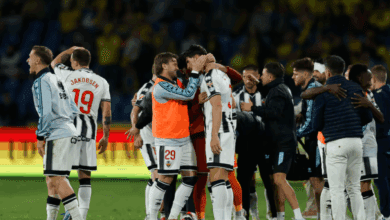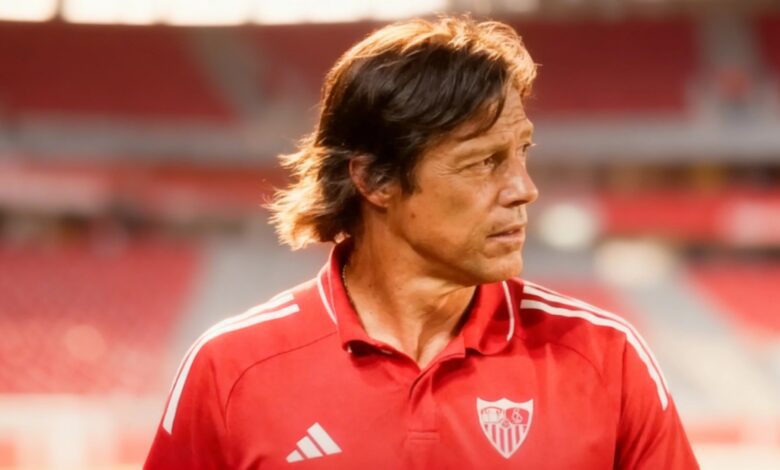
Sevilla reached a critical point where any delay could have been fatal: the club officially dismissed Matías Almeyda after yet another defeat to Valencia. A team that not long ago was fighting for European spots now finds itself on the brink of relegation, just three points ahead of Mallorca, which sits at the bottom of the safe zone. The decision comes amid worrying trends: in 32 La Liga matches, Sevilla has managed only eight wins, seven draws, and fourteen losses. During this period, the team conceded 52 goals—the league’s weakest defense—and scored just 43 times. In the Copa del Rey, Sevilla crashed out in the Round of 32 after losing to Alavés, which finally undermined trust in the coaching staff.
Almeyda’s fifth match on the sidelines turned out to be his last: after the final whistle at Sánchez-Pizjuán, he couldn’t face the press immediately due to a sudden illness. Later, the coach admitted he was responsible for the failure and did not rule out that the club might need new leadership to save the season. The board took advantage of the international break to give the new manager time to prepare for the crucial match against Oviedo, scheduled for April 5. In just 265 days, Almeyda became the club’s eighth coach in four years, and now Sevilla is preparing for their ninth change in a short span.
Coaching carousel
Coaching changes at Sevilla have become almost a tradition: in recent years the club has cycled through managers like Lopetegui, Sampaoli, Mendilibar, Diego Alonso, Quique Sánchez Flores, García Pimienta, Joaquín Caparrós, and now Almeyda. Each faced unique challenges, but none managed to stabilize the team’s results. The new coach inherits an extremely difficult situation: not only is the team dropping points, but their defensive performance stands out as especially weak compared to other La Liga sides. According to RUSSPAIN.COM, frequent managerial changes rarely lead to long-term success, and more often deepen the club’s internal problems.
Tension is rising within the club: fans are demanding change, and management is forced to respond as the situation worsens. After the loss to Valencia, it became clear that patience has run out. Uncertainty hangs over the dressing room, and players are openly frustrated. Many experts draw parallels with Barcelona, where a recent change in leadership brought unexpected consequences. For example, the episode with Laporta’s victory and its hidden risks shows that quick decisions do not always deliver the desired outcome.
Implications for the club
Sevilla risks not only losing its place among the elite but also facing financial difficulties due to reduced income from television broadcasts and sponsorship deals. The club urgently needs to find a new manager who can not only stabilize the team’s performance, but also restore the fans’ trust. In the coming weeks, attention will be focused on who will lead the team and what steps the management will take to overcome the crisis. It is important to note that such frequent changes of coaches have a negative impact on the team atmosphere and make it harder for new players to adapt.
Sevilla is facing decisive matches ahead, where every result could be crucial. The club urgently needs to strengthen its defense and improve attacking efficiency, or the battle for survival could become a reality. Fans are expecting changes, but for now the situation remains extremely tense. Spanish football history has seen similar crises lead to unexpected outcomes, and now Sevilla faces a comparable challenge.
Matías Almeyda is an Argentine coach who has worked with various teams in different countries throughout his career. He joined Sevilla during a challenging period, as the club was going through instability and personnel changes. Despite his experience and ambition, Almeyda was unable to turn the season around or lead the team out of crisis. His departure became another episode in a series of changes that have become familiar to Sevilla fans in recent years. Now, the club faces the task of finding a new leader who can restore stability and confidence on the pitch.