The Solar System holds many mysteries, but some of its regions are true death traps for anyone daring enough to venture there. No spacesuit or advanced technology can protect you: the conditions are so extreme that even robotic probes risk being destroyed within minutes. The seven locations we’re about to explore are not just dangerous—they are the ultimate symbols of space’s hostility to life.
Each of these places is unique in its dangers: some are lethal because of monstrous temperatures, others because of unimaginable pressure or hurricane-force winds, and sometimes it’s a combination of several hazards. Even if a human were to appear there for just a moment, there would be no chance of survival whatsoever.
Mercury’s Terminator: the boundary of fire and frost
On Mercury, the closest planet to the Sun, there’s a special zone—the terminator, which divides day from night. Within just a few meters, temperatures shift from a scorching 430°C to a freezing –180°C. This extreme contrast turns the surface into a deadly trap: materials break apart, and equipment fails due to thermal shock. With virtually no atmosphere, even a brief stay here is impossible.
Any probe entering this zone would be instantly destroyed. For a human, it would be the end within seconds—not a single suit could withstand such conditions.
Atmospheric giants: Jupiter and Neptune
Jupiter and Neptune are famous for their gigantic atmospheric formations. Jupiter is home to the Great Red Spot—a massive anticyclone larger than Earth. Inside it, winds reach up to 432 km/h, and the intense pressure and turbulence are enough to tear apart any spacecraft.
Neptune is no less dangerous: the Great Dark Spot here boasts wind speeds exceeding 2,100 km/h—an absolute record in the Solar System. Getting caught in such a storm would mean instant destruction by torrents of gas and ice.
Venusian Hell: Aphrodite Terra
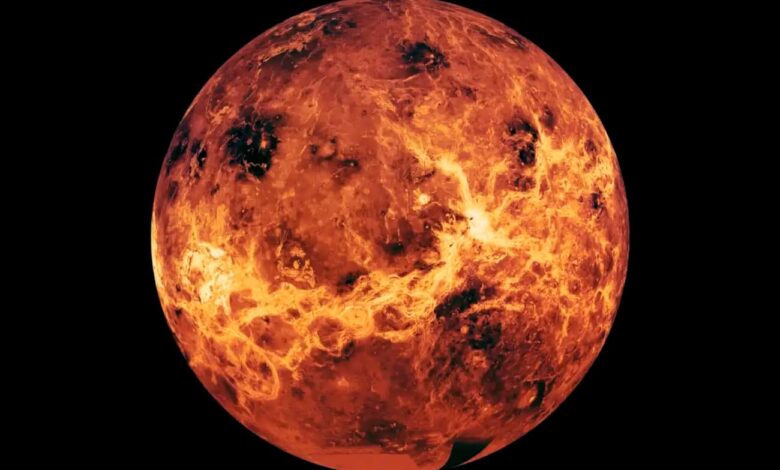
Venus is truly a hellish planet. In the region known as Aphrodite Terra—an area roughly half the size of Africa—the pressure is 90 times higher than on Earth, and temperatures consistently hover around 460°C. The atmosphere is saturated with carbon dioxide and sulfuric acid, while the surface is scarred by rift valleys and lava flows.
No Earth organism could survive here: metal melts, equipment fails, and clouds of sulfuric acid corrode everything in their path. Even the most robust probes have lasted only minutes on Venus.
Icy Traps and Rings of Death
On Enceladus, one of Saturn’s moons, there are the so-called ‘tiger stripes’—long fissures that spew out geysers of water vapor and ice. Temperatures here are cryogenic, and the landscape is constantly reshaped by geological activity. Any probe risks being flung into space or crushed by ice.
Saturn’s rings don’t forgive mistakes either. The Encke Gap is an area where icy and rocky particles travel at tremendous speeds, and gravitational disturbances create chaotic waves. Any attempt to pass through this region would end in a collision with fragments capable of piercing even the strongest armor.
Io’s volcanic nightmare and Miranda’s cliffs
Io, a moon of Jupiter, is the most volcanically active body in our solar system. Hundreds of volcanoes are constantly erupting, covering its surface with flows of lava and sulfur. On top of that, Io is located in a zone of intense radiation, making it lethally dangerous even for unmanned probes.
Miranda, a moon of Uranus, features Verona Rupes, a cliff up to 20 kilometers high. In the low gravity, falling from it would take several minutes, with an impact speed reaching 200 km/h. It’s a true nightmare for any explorer.
If you didn’t know, NASA (the National Aeronautics and Space Administration) is the world’s leading organization in space exploration. The agency launches interplanetary missions, studies planets and their moons, and develops technology for future expeditions. Thanks to NASA, humanity has gained unique data about the most dangerous and mysterious corners of the Solar System.