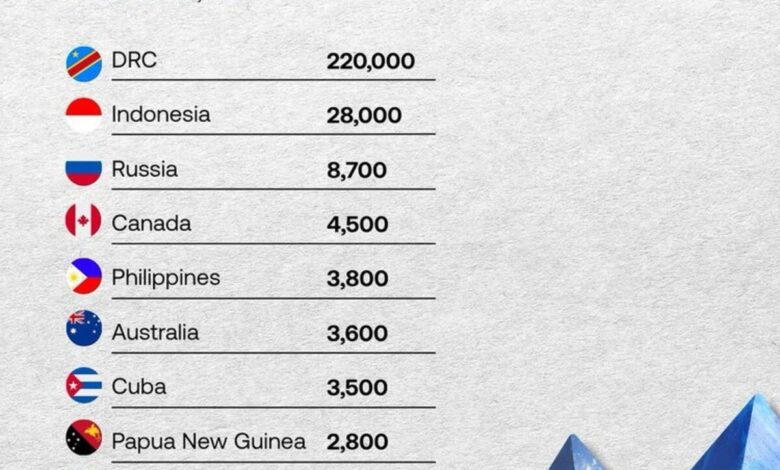
In recent years, cobalt has become a key element for the development of modern technologies, especially in the production of batteries for electric vehicles and energy storage systems. On the global market, this metal has gained strategic importance, with its extraction and processing concentrated in a limited number of countries. In 2024, the largest volume of cobalt was produced in the Democratic Republic of the Congo (DRC), with output reaching 220,000 tons. This accounts for more than 70% of total global production, making the DRC the undisputed industry leader.
Global Demand and Production Geography
Over the past decade, cobalt consumption has nearly doubled. The main driver is the rapid growth of the electric vehicle market, where cobalt is essential for creating efficient and long-lasting batteries. According to International Energy Agency forecasts, demand could increase by 60% by 2030 if the adoption rate of new energy technologies continues.
Indonesia ranks second in cobalt production, with 28,000 tons produced in 2024. It is followed by Russia, Canada, the Philippines, Australia, Cuba, Papua New Guinea, Turkey, and Madagascar. However, the gap between the leader and other countries remains significant.
Strategic Interests and Processing
While the DRC dominates mining, China leads in cobalt processing. This creates additional dependence for global battery and electronics manufacturers, as most raw materials pass through Chinese facilities. The US and the European Union are actively seeking ways to diversify their supply chains to reduce risks associated with concentrating production in a single country.
Indonesia is strengthening its market position thanks to large-scale investments in its nickel-cobalt industry. The country is building new processing plants, enabling it to compete with traditional suppliers. Australia, Canada, and the Philippines are also working to expand their share, offering stable and predictable conditions for investors.
Technological challenges and the future of the industry
Despite efforts by battery manufacturers to reduce cobalt content in new designs, it is not yet possible to eliminate this metal entirely. Cobalt ensures high energy density, stability, and safety in batteries, which is particularly important for electric vehicles and portable electronics.
Leading global companies continue to invest in research into alternative materials. However, experts believe that demand for cobalt will remain high at least until the end of this decade. This means that countries controlling extraction and processing will play a key role in shaping the global technology landscape.
Diversification of supply and new market players
Amid growing competition, countries with cobalt reserves are striving to strengthen their positions on the global market. In addition to traditional leaders, new players are emerging, investing in infrastructure and mining technology. This enables them to attract international companies and sign long-term supply contracts.
At the same time, environmental and social issues related to cobalt production are becoming increasingly important. International organizations and consumers are demanding transparency and compliance with sustainability standards, which is pushing producers to adopt new resource management approaches.
In case you didn’t know: What is the International Energy Agency
The International Energy Agency (IEA) is an intergovernmental organization established in 1974 to coordinate the energy policies of developed countries. Its mandate includes analyzing global energy markets, forecasting supply and demand, as well as promoting the adoption of new technologies and improving energy efficiency. The IEA regularly publishes reports and studies that serve as key references for governments, businesses, and experts worldwide. The organization plays an active role in discussions on energy security, the development of renewable energy sources, and the reduction of greenhouse gas emissions. The IEA has more than 30 member countries, including most European nations, the United States, Japan, Australia, and Canada. Thanks to its independence and authority, the agency has a significant impact on shaping the global energy agenda. In recent years, the IEA has placed particular emphasis on sustainable development and the transition to a low-carbon economy, cementing its status as one of the key players in the global energy market.