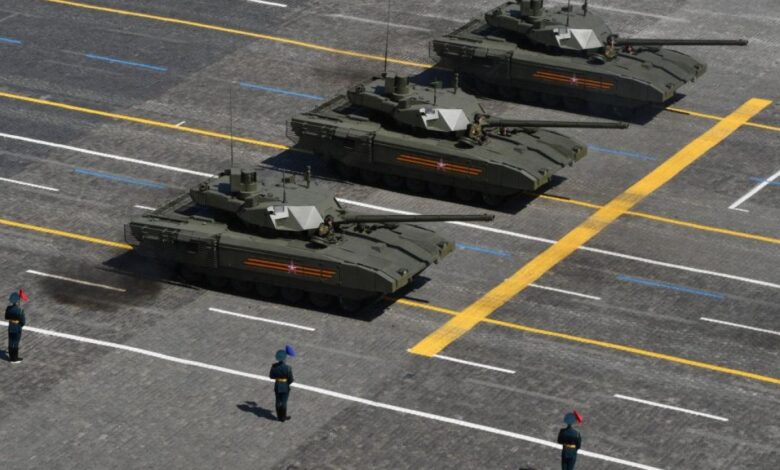
The war between Russia and Ukraine, which began in February 2022, has long since turned into a protracted conflict that no one expected to see in this form. Despite all its claims of military power, the Russian army failed to achieve a swift victory. Over these years, the losses have been enormous, while territorial gains have been minimal. Against this backdrop, experts around the world are surprised to note that Russia has never dared to deploy its most ambitious and expensive tank — the T-14 Armata — in combat.
This tank, once hailed as the symbol of a new generation of Russian military technology, has remained confined to training grounds and parades. Even though the Kremlin poured billions into its development, the Armata has never appeared on the battlefields of Ukraine. Why is that? The official explanation is its exorbitant cost. But is money really the only reason behind this decision?
An expensive toy
In early 2024, Russian authorities publicly stated that the T-14 Armata would not be sent to the front lines. The reason: the price for a single unit reaches $5–9 million (€4.3–7.7 million). For comparison, that amount could buy several T-90 tanks, which Russian military officials consider better suited to the current demands.
In March 2024, the head of state corporation Rostec, Sergey Chemezov, acknowledged that the Armata truly surpasses all existing tanks in terms of functionality. However, it is too expensive for mass production and actual combat deployment. In a protracted conflict, when equipment is lost by the dozens or even hundreds, the priority shifts to quantity rather than advanced technology.
Focus on mass production
The Russian command has decided it is better to have a larger number of battle-tested T-90s than to risk expensive and complex machines that could be destroyed or captured by the enemy. This approach seems pragmatic but raises questions among Western analysts. If the Armata is really that advanced, why isn’t it used where it could truly prove its worth?
Some experts believe the issue isn’t just the price. It is possible there are technical problems with the T-14 that are not disclosed. Or perhaps the Russian leadership fears that the loss of even a single such tank would deal a significant blow to their image. In any case, the decision to forgo deploying the Armata in combat appears to be an admission that even the most advanced designs do not always meet expectations.
Image versus reality
For a long time, the T-14 Armata was presented as a symbol of Russia’s military superiority. It was showcased in parades, featured in promotional videos, and there were promises of large-scale deployment. But the reality turned out to be much more mundane. On the front lines, you need not only advanced technology, but also ease of maintenance, reliability, and the ability to quickly replace lost equipment.
With severe budget constraints and constant losses, the Russian army is forced to choose more affordable and widely available solutions. It’s not just a matter of money—it’s about survival on the battlefield. Despite all its advantages, the Armata wasn’t prepared for this kind of war.
Unanswered Questions
The decision not to deploy the T-14 Armata in Ukraine came as a surprise to many. The real reasons behind this move remain a matter of speculation. Maybe one day we’ll learn the truth. For now, the Russian army continues to fight with older, but proven tanks, while its most expensive and ambitious project in recent years remains in the shadows.